
Roughly every other year, my friend JT and I try to get together for a fishing trip.
The first iteration of this informal tradition involved meeting him at his parents’ cabin in northern Minnesota. The next time, we split the trip between the cabin and my house in Sheboygan Falls, Wisconsin. Bass fishing during the first leg of the trip and capitalizing on the fall salmon run during the back half.
This time, we decided to meet somewhere more in the middle. While I don’t recall how the topic came up, we chose the Mississippi River. JT had some experience with the area, having lived in La Crosse for a spell in his early post-college days, I had never fished the big river. I had many successful duck hunting trips there but, for some reason, had never wet a thread in those muddy waters. I was excited to change that.
We decided to score a campsite right on the river for four days and three nights. Unlike JT, I had minimal experience with camping. But I was all for maximizing our fishing time. The plan was simple: he would provide the boat and all tackle needed for bass fishing. I would bring everything we needed to chase catfish from shore.
As the trip approached, we started firming up logistics. It was then I learned that many of JT’s fishing “camping” trips involved sleeping in his vehicle and living off canned fish, jerky, and energy drinks. The meal plan took precedence over fishing talk, at that point.
The forecast was a downer. Temperatures in the upper 90s with heat indices north of 100 and almost no wind to speak of. But it wasn’t calling for rain, that was something.
It was Monday afternoon, just before 1, when I rolled into the campsite. Home, for the next few days, was Pettibone Campground, just west of La Crosse and about as close to the Wisconsin/Minnesota border as you can get. It is positioned on a peninsula with the main river hugging the west side and a back channel on the east.
After checking in, I drove through the gate and down a narrow one-way road that hugged the shaded camp sites on the main river channel and drove until I saw a familiar 18.5-foot blue Caymas behind a SUV with North Dakota plates.
I parked the truck, gave JT a hug, and immediately grabbed my rod holder, a spinning setup, a pack of worms, and got a line in the water. We were here to fish, after all. Without saying a word, JT followed suit, grabbing another one of my bottom rigs out of the bed of my silver gray F-150, tossing it out and setting it in pole holder next to mine. This is one of the many reasons we are friends.
Once the dead rods were set, I tossed out a slip bobber setup near the shoreline that was dotted by rocks. As we caught up and talked strategy for the rest of the day, I scored a smallmouth bass and a couple bluegill on the bobber.
As the sun continued its westward journey, our shade began to disappear rapidly. JT and I decided it was time to fix a quick late lunch, bologna and pepperjack sandwiches, and take the boat to the launch down the road and hit the water. The plan was to beat the heat by banging docks with plastics in hopes of coercing some reluctant bass into striking.
With the boat afloat, we headed north to check out some of JT’s old haunts on the Black River, which empties into the Mighty Mississippi near downtown La Crosse. Arriving at our first set of docks, JT put the trolling motor in and handed me a rod with a weightless fluke rig. His had a swim jig tipped with a paddle tail. We got to work.
Just in case we could ignore it, the heat quickly made its presence known. My phone told me it was 92 and would stay that way for the next several hours. But I didn’t need technology to explain that. We just had to sit back in our seats during runs between spots. The upholstery was scorching, even if we were only off it for a few minutes to investigate a small set of docks. On our quick jaunts, Jt would lean his hat over the rail, soak it thoroughly and promptly place it back on his head.
And this wasn’t even supposed to be the hottest day.
The fish clearly took note of the heat too. We were marking them but, man, they weren’t moving. They clung tight to their treasured shade. Eventually, I managed to talk a medium northern pike into chasing my plastic out from under a boat house. It wound up and, with a gold flash, took one mighty swing. It briefly connected with the bait but, shortly after I set the hook, decided it wasn’t in the mood for a fight and simply let the plastic minnow go. JT was still searching for his first strike.
In the lead-up to the trip, I decided to bring an ultralight with a slip bobber on the boat just in case we ran into a situation like this. The way I saw it, if we were marking fish, but not getting bit, a nightcralwer under a bobber would be the fastest way to get a read on what we were dealing with. We had that rod onboard but, there was a problem: I left the worms in the cooler back at the campsite. I’ll blame it on my excitement.
Ultimately, after moving back to the Mississippi and not finding any luck, we decided to reset with a swim break. JT pulled up to one of the several beaches that line this stretch of the river and put his power poles down. We both hopped out of the boat. Though the water wasn’t all that much cooler than the air, it was incredibly refreshing.
We decided to fish our way back to the boat launch, hitting up the spots that showed most promise. At this point, the main objective was just getting a fish in the boat to get our mojo going and to give us something to build on the following day. We were on the second longest river in the country, there were plenty of places we could see fish on screens, we needed to find some that were willing to bite.
Eventually, I broke the ice with a solid smallmouth I pulled off a weed edge on the upriver side of one of the several bridges we encountered on our way upriver. Shortly after that, JT hooked up with a much larger bass but lost it. That was the end of our action on the boat for our first afternoon. We were both a but discourage, but remained optimistic we’d come up with a plan. At least we were on the board.
Back at camp, we immediately put the dead rods out and started fishing near the rocks with bobber setups in the meantime, while we hopefully waited for the bottom of the river to come to life. Our shade was gone, but sunset was coming in about two hours. Following JT’s example from earlier, I stayed cool by occasionally running my hat under the water spigot at our site and putting the soaked fabric back on my head.
While I wasn’t surprised there were hungry sunfish hanging out near structure, I was was not prepared for their size. They were stout. Nearly every one of them sitting in the 8-to-9-inch range. I figured it might be time to start keeping a few. I brought supplies for a fish fry, but the idea of cleaning fish didn’t seem appealing at the moment.
As night began to fall, we scored a few more sunfish and a smallmouth on the bobbers along with a couple sheephead and a common carp on the dead rods.
A man walking a pair of small dogs wandered over from the campsite across from us. He had just pulled in with a big RV that was pulling a white pickup with Arizona plates. He asked how the fishing was and we struck up a conversation. Over the course of the next 15 minutes, we learned that he was a retired Southwest Airlines pilot and he and his wife were in the middle of a cross-country tour. “I’ve seen a lot of this country, but most of it has been from 30,000 feet,” he explained.
The couple had just come in from South Dakota and were making their way through Wisconsin en route to the UP and, eventually, Maine. One of the two very friendly dogs was a rescue from a mission trip he and his wife took to Mexico.
Meanwhile, the fishing action wasn’t frantic, but it was something. If nothing else, it was more than enough to keep us entertained, proven by the fact that it was dark out before I realized I hadn’t bothered to inflate my air mattress. Thankfully, it was finally cool enough to light a fire to cook dinner and we used the residual light to correct that issue.
The only nice thing about the weather was that the rain fly on the tent was required. As I laid on my freshly-inflated air mattress, I had a spectacular view of the stars with the Big Dipper directly overhead.
We rose before the sun the following morning and I immediately got rods in the water and went to work preparing breakfast: bacon and fried-egg sandwiches. As I prepped ingredients on the picnic table, I noticed I was short one slice of bread. I quickly found it scampering up a tree a few feet in front of me. Apparently, a squirrel had snuck down while I was lighting the fire and claimed the bread for itself. No real harm done, I suppose.
Since the first afternoon gave us much information outside of what not to do, we tried something completely different. After putting the boat in the water, we powered south for a good while. The plan was to get in as much fishing and learning as we could while temperatures were still manageable.
During the ride, I started to realize that the Mississippi River is many things to many people. It’s special blend of natural, urban, and commercial backdrops where both recreation opportunities and the very livelihoods of many of the people who live here.
We started by tossing bass baits on rock piles and weed lines near a point where a side channel met the big river to no avail. Then we tried the backwater with the same results. Sure, conditions weren’t ideal but this was starting to get in our heads. Shortly after noon, we chose to call it quits, fishless.
On the way back to the boat ramp, JT suddenly veered to the right. “Oh, well this is about to get interesting,” he said. I assumed he was talking about navigating the buoys ahead of us that marked a shallow passage. But I was wrong. He started making his way toward a pontoon boat a couple hundred yards from us. “They are flagging us down,” he added.
Sure enough. Despite flying up the river at full tilt, JT had spotted four people on the boat waving at us. As we slowed down for a close approach, one of the men on the boat told us their gas gauge wasn’t working. The new part they ordered didn’t come in before their trip, so they decided to top off the tank and risk it. They were on their way to the gas station for more dinosaur juice, but ran out of fuel about a quarter mile short of their destination.
It appeared to me the pontoon’s occupants were a pair of couples, I’d put them in their mid-to-late-50s, who were out on a leisure cruise, as evidenced by the fact they were all in swimsuits and holding adult beverages. The group informed us they had only seen two other boats and both passed them by. They thanked us profusely for stopping.
Before long, we had them tied up to the back of our boat and slowly puttered toward the gas station. When we arrived at the slips, one of the couples slipped JT $40. We insisted that wasn’t necessary. “At least get yourselves some beer,” the man said with a laugh. As good as a cold beer sounded, our greater need was ice and firewood. So that’s where we invested the newly-acquired funds.
Once we made it back to camp and ate lunch, we decided to enjoy the refuge of the shade by fishing the back channel on the other side of the grounds. We parked ourselves under the biggest tree we could find in an unoccupied site and tossed our bottom rigs into the middle. The relatively narrow channel appeared shallow and swampy, like something I’d imagine you’d find in Louisiana’s portion of the river.
We weren’t getting bites, but we were out of the sun and there were fish around. The guy fishing on the opposite bank told us he had just caught a pike on his spinning before we arrived. He also had a bottom rod out, so I felt confident in saying we weren’t stupid. But that fact didn’t get us any bites. As afternoon turned to evening, it was time to get back in the boat.
We opted to head back north, since we at least had some action that direction. The goal was to ultimately end up at the dam, but we planned to stop at a few wing dams along the way.
Our first stop was a submerged wing dam that separated a mud flat off the main channel from the back waters. Its presence was noted by a handful of white buoys. There were signs of life. We could see fish surfacing on the downriver side. JT approached with caution, anticipating shallow water. That suspicion was quickly confirmed as a boat came flying in behind us, only to be met with the loud thud of a wide-open prop violently meeting bottom. The boat slowed to a crawl.
“That’s what I was afraid of,” JT said as he switched from the main motor to the trolling motor.
As tempting as our prospective spot was, we decided the juice wasn’t worth the squeeze. JT turned the boat around and slowly moved back toward the mud flat, dodging rocks and shallow spots, mostly successfully.
With the boat anchored, we tossed about a pair of dead rods with nightcrawlers. We moved the rods to the driver’s side of the boat so we could hop in the water to cool off while we waited for action.
Surprisingly, it didn’t take long for action to come. I had just climbed down the rear boat ladder when the rod by the driver’s seat started bouncing. JT picked it up, gave it a yank and the rod stayed bent.
“Is he there?,” I asked almost incredulously.
“Yup,” said JT and he started to reel down on the fish. “Feels good.”
I quickly reeled up the other line to allow space for the ensuing battle to play out.
At that point, I realized I was in no position to grab a landing net in a timely fashion.
“You’re going to have to walk him to the shore,” I said gesturing toward the island to our right.
JT did just that. As the splashing gave way, the fish’s identity was revealed: it was a bowfin. I had never seen one in person.
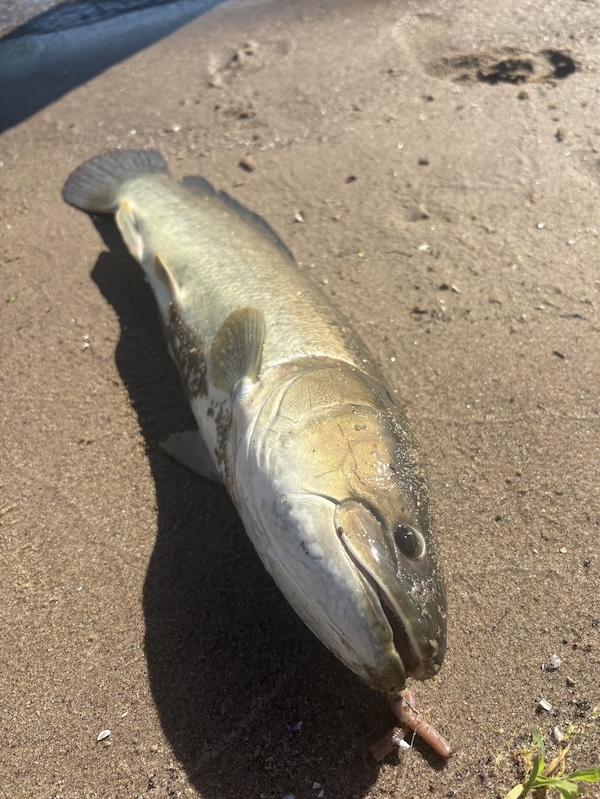
These odd-looking fish have prehistoric origins. One of only two surviving members of Halecomorphi, their lineage traces back to the early Triassic Period, some 250 million years ago. Now that’s a cool catch.
Using a pliers to dislodge the hook from the fish’s bony jaw, JT got it back in the water. Maybe we were finally on to something. But there was only one way to find out: getting both rods back in the water.
We headed back to the boat to do just that. About 15 yards away, I felt a sharp pain in right foot. I found a stray rock, a jagged one, apparently and I wasn’t wearing footwear (something you should never do while walking in the water, by the way). I was definitely cut. It hurt, but it didn’t seem too bad.
I gingerly made my way back to the ladder and cautiously climbed it. I plopped down in the shotgun seat to assess the situation. But, before I could, JT spoke up from the back platform. “Dude, are you OK? This looks pretty bad.”
As I glanced toward him, I saw a solid trail of blood. It looked like someone had shot a deer in the boat.
Before I could even check my foot, my anxiety started racing. The thought of needing stitches wasn’t great.
Against my better judgment, I took a peek. My worries quickly subsided. It was a small puncture wound that wasn’t horribly deep. The crime-scene-type appearance of the boat floor was a product of the river water dripping off my body and diluting the blood, making it look significantly worse than it actually was. We busted out the ol’ med kit. I put some antiseptic gel on my new wound, put a bandage on it, and we were good to go.
It turned out the quick bowfin strike wasn’t a harbinger of things to come. The next half hour didn’t yield a single bite. It was time to power up to the dam.
After a short ride, the boat slowed and we scoped out spots while the boat idled in the current. Our first choice was a dock at the base of the dam on the upriver side of a wing dam. JT explained to me the dock was owned by a business that offered shore anglers prime opportunities on both sides of the river in exchange for a modest fee. This afternoon, however, it was deserted.
JT pitched bass baits into the shade while I set out the dead rods. Once those were ready, I picked up my ultralight slip bobber rig and started investigating the dock pilings. Every once in a while, we’d catch the flash of a gar chasing prey near the surface. But the rods remained silent.
Eventually, we moved down to the next wing dam and repeated the process. For a while, with similar luck.
But then, the tip of the pole with a bottom rig at the front of the boat started bouncing. It was nothing urgent, but definitely a a bite. I made my way to the bow, slowly reeled up the slack, and felt a bit of tension. I set the hook and was greeted by pure weight. Truthfully, it almost felt like a snag. If I hadn’t seen the rod tip moments before, that would have been my diagnosis. But I knew better. Plus, I was gaining ground despite the fact the boat was anchored. That wouldn’t happen with a snag.
After I pulled about 20 yards of line in, my suspicions were confirmed when I felt a head shake. This was, indeed, a fish. Clearly, its plan to escape the current predicament was to get as heavy as possible.
It worked.
As JT went to grab the net, the tension on the line released. The rod went limp.
Whatever it was, it was big and it was gone. Upon further inspection, a faulty knot and a drag set way too tight were to blame. It was no one’s fault but mine. But, in my defense, I’d argue the heat was a factor. You make stupid, sloppy mistakes when you’re hot and tired. These are amateur errors. I’m not a pro, I know I’m better than that.
Morale was low. Don’t get me wrong, we were both still glad to be on this trip. But things weren’t going to plan. We were hot, tired and, despite going through two bottles of sunscreen, sunburned. Bank fishing continued to be solid but our time on the boat yielded shockingly few fish, even considering the conditions. We only had one full day of fishing remaining and the only real information we had to build on was a handful of near misses. That’s not much, given how much water there was to cover.
The next morning, we decided to go all-in on our pursuit of catfish and other bottom feeders. Truth be told, I had made that call the day prior. Unfortunately, bass fishing wasn’t yielding results. We started our day with a trip to a local bait shop at nearby French Island that JT frequented during his La Crosse days. Our new focus required some heavier tackle, namely bigger sinkers to better navigate the current and some actual catfish hooks.
JT chatted up the owner who was behind the counter. He validated our frustrations by saying bass fishing had been tough for a while. But he had heard of a few people having success chasing cats. It seemed our approach was the right one or, at least, the best we could hope for.
Freshly re-stocked and re-tied, we got back on the boat and headed north. We deemed this particular Wednesday, “Redemption Day.” The plan was to head back to the wing dam where we had our most recent close call and spray the area with bottom rigs tipped with a mix of red worms, nightcrawlers, and catfish bait.
Since we had some rods to spare from a legal standpoint, JT started throwing for bass on the wing dam side of the boat. I went for a slip bobber rig with a crawler on it. I picked up a bluegill, followed by a decent largemouth. All of a sudden, JT was starting to find his own largies at the back of the boat. We weren’t hammering them by any stretch, but it was the best action we had on the boat all week. It felt good to get our mojo back.
A short while later, one of the dead rods started slowly bouncing. It was steady, for a while, but didn’t come across as urgent. I made my way back to the boat, reeled up the slack and gave a gentle tug. There was certainly resistance, but it was hard to make heads or tails of what was happening. I gave another, stronger hookset as insurance. There was weight there and I started slowly gaining ground.
“Got one?,” JT questioned hopefully.
“I think so,” I replied.
I continued reeling when I finally felt a headshake that confirmed the presence of life on the end of my line.
“Yup, there he is,” I said with a strain.
Moments later, a fish came flying out of the water, drawing ohs and ahs from both of us.
“Yes, dude!” JT exclaimed, grabbing my shoulders and giving me an encouraging shake.
“Get the net, he’s close!,” I fired back, in a more stern tone than I meant to. I didn’t want to squander this chance.
JT quickly scrambled for the net. Based on the brief glimpse of the fish, our working theory was we were dealing with a gar.
Not long after, I had worked the fish boatside. We couldn’t see it, but I could tell this battle was reaching its conclusion, one way or the other. Splashing started on the surface and JT plunged the net overboard. With one fluid swoop, the fish was in the boat.
Finally.
To our surprise, my combatant was actually a small lake sturgeon, a touch over 30 inches. We were stoked. High fives and hugs were exchanged as JT grabbed the pliers. This was my first sturgeon. Heck, it was the first one I’d seen in person.
While it wasn’t the target, this was the kind of fish we came for: something neither of us had much experience with.
Having never handled a sturgeon before. I got a crash course on scutes: the modified scaled that line sturgeons’ sides for protection. These bony protrusions are super sharp, like the tip of a knife or an arrowhead. JT have me a wet rag to save my hand.
We took some pictures and got the fish back in the water. We were in disbelief but fired up and our spirits lifted.
The bottom rigs were quiet the rest of the time we spent in that spot. But we managed a few more largemouth and were feeling good.
JT had a couple docks he wanted to pound on the way back. As he did that, I stuck with my slip bobber at the back of the boat. For me, any fish that followed the sturgeon was gravy.
It didn’t take long for me to pull in our biggest bass of the trip out of some shaded timber near the bank, followed by another large sunfish. Then JT started getting into the bass himself. At one point, yanking two out of the same spot over the course of a few casts.
Ironically, our best bass fishing came when we decided it was no longer the focus of our boat trips. “Redemption Day” came to fruition.
Once we got into the fish, we quickly learned that it wasn’t docks holding active bass, it was shaded timber. And seemingly every similar spot we found held a hungry fish. We were rolling now. It just took three days of nearly nonstop fishing.
Back at camp, we hit up a quick mid-day cold shower and made lunch while we figured out our next steps. We chose to go back to the channel from the previous day and enjoy the shade. So, we went back to the unoccupied campsite that had become our early-afternoon oasis and set up our bottom rigs.
We pulled up a seat on the patchy grass near the bank and shot the breeze. After a while, the conversation slowed. There was little wind to speak of and almost no noise other than the occasional song of a bird or a chirping cicada. I snapped out of my half daydream when the door of the camper to our right shut.
A tall, well-built, tattooed man with a tank top, shorts, and sandals emerged. I put him in his mid- to late-40s. On first glance, it’s the kind of guy you hope is approaching because he is happy to see you. Well, we were about to find out. I hoped to get a quick read on the situation.
“How you guys doing?,” he asked as he walked closer.
Now, that’s often how my friends greet me. But I’ve also heard that from plenty of on-edge people who couldn’t give two shits about the actual answer to the question.
“Good,” we answered in unison.
“How’s fishing?,” he followed-up.
We told him things were slow and how we didn’t catch anything here the day before, but we’re grateful for the shade. He then explained to us that there was a small hole right behind his camper that usually held fish. That spot was where the no wake zone ended. So the boats coming down river would drop the hammer as soon as they crossed the threshold and, when they did, displace the silt off the bottom with their prop wash.
“That’s the spot you want,” he added. “Bring your stuff over.”
We did as instructed as he directed us where to put our rod holder. We casted rods out as he pointed out the rough dimensions of the hole.
Once we were set he added, “If you guys are going to fish here, I am at least going to watch and see what happens. Hold on, I’m going to grab a beer.”
He briefly disappeared back into his camper before coming back out with a cold can and a lawn chair. He posted up right next to JT.
“You guys want a beer?,” he inquired.
JT obliged. I declined. In hindsight, I probably should have accepted the goodwill gesture too. I was just tired of taking in liquids only to sweat them out. At this point in the trip, I was averaging over 200 ounces of fluids per day but rarely needing to make the trek to the bathroom.
With everyone settled, I introduced myself. “I’m Nathan, nice to meet you,. Thanks for letting us do this.” I said, extending a hand.
“Chris,” he responded with a firm handshake, “Nice to meet you.”
Making conversation with Chris was easy. Between fishing advice, he wove in details of his backstory. He was born and raised in Minnesota, just like JT. He was a general contractor who was also a snowbird. He and his wife lived at the campground during the summer and spent the rest of the year in Florida.
“We’re kind of homeless now,” he said, gesturing toward his camper.
Eventually, we were interrupted by one of the alarms on the rod holder going off. JT grabbed the rod and set hook. After a brief skirmish, he landed our second bowfin of the trip.
Chris called his wife out of the camper to come see it. Apparently, she had never seen one.
The conversation then moved to trucks and motorcycles. He explained that he wouldn’t allow himself to get his Harley Davidson tattoo until he put at least 500,000 miles on his bike because he didn’t “want to be one of those guys.”
I busted out the slip bobber rod and quickly hooked into a carp. Though my equipment wasn’t ideal for the fight, I landed the fish. A short while later, I lost a small longnose gar right at shore. It saw the net and simply let go because, as often happens with gar, it hadn’t actually been pierced by the hook. It was simply holding on to the worm and playing tug o’ war. Though the fish wasn’t big, that one stung. It would have been a new species added to my life list.
We told Chris how we had come up empty on the catfish front.
“If you want to catch a catfish, stop on over around 9. Fish this hole and I promise you’ll get one. Pound on the door so I can come watch. Beer is in the fridge, help yourselves.”
“We might take you up on that,” I said. “Depending how long we spend on the boat.”
Besides wanting to take advantage of another gracious offer, it was nice to know we had an option in our back pocket to achieve one of our last goals of the trip. Time was running out.
We said our goodbyes and offered a final thank you before heading back to our site and loading up the boat for what would likely be our last trip on the water for the week. Our plan was to finally land the catfish we were after, but it didn’t happen. Nearly four hours on the Caymas didn’t net us a single fish.
All hope was not lost, though. Immediately upon our return to camp, we got rods in the water while we waited for the temperature to cool so we could start a fire to cook dinner: steak and potatoes, to celebrate our adventure.
We found action early, but it was exclusively sheephead. So there wasn’t reason to get overly excited when one of the rods went right after sunset.
JT picked it up and gave it a tug. He connected.
When the fish got closer to shore, JT’s energy shifted.
“Dude, it’s a kitty!,” he exclaimed.
At that point, I realized we didn’t have the net nearby. I ran over and grabbed it and began my hurried descent down the steep, rocky bank in fading daylight, hurt foot and all. After what felt like forever, I was at the water’s edge. Sure enough, it was a channel cat. Nothing huge, but far from a dink.
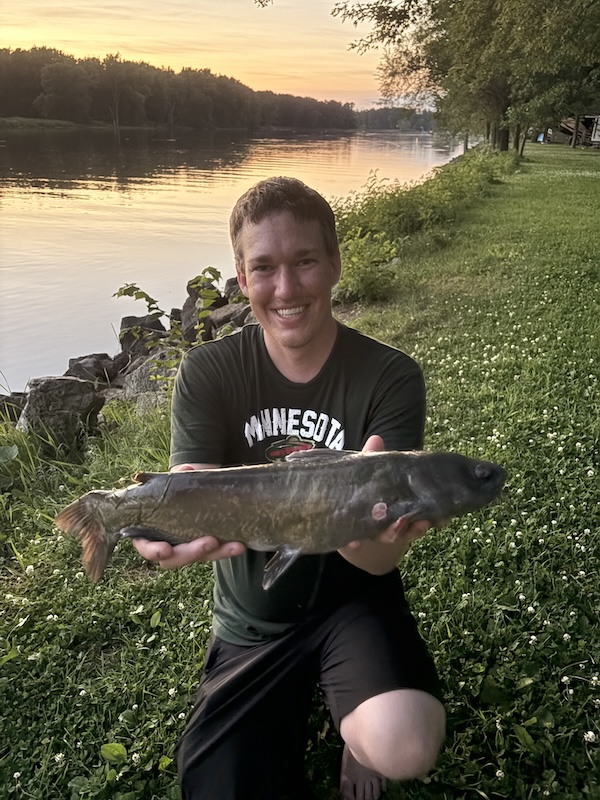
I went to scoop the fish when it wedged itself between two of the rocks. I placed the net behind its tail to prevent an unfortunate escape, should the line fray on the jagged rocks.
A brief game of fish Tetris ensued, but I eventually emerged the victor. We did it. We got our cat.
That was the cherry on top of what had been the best day of our trip, by far.
We enjoyed our gourmet campfire meal with an extra sense of accomplishment that night. As we got into our tent, we were treated to a vocal performance from a pair of barred owls who were over on the channel by Chris’ camper. The familiar calls of “who cooks for you?” answered by noises I had never heard an owl make before.
When we awoke the next morning, we were greeted with the first wave of thick wildfire smoke that was about to descend on the area. Our trip was ending just in time.
We made breakfast with our leftover steak and the rest of our eggs before packing up camp. We caught a few more fish for good measure, too.
A little after 9 a.m., JT and I were near the campground entrance, ready to go our separate ways.
It was a whirlwind of a trip, filled with emotions. At times, it was physically and even mentally taxing. But it was worth it. We experienced new water, caught new species of fish, and met some interesting people while getting to spend quality time with one another.
We’ll be back.


Leave a comment