About 10 years ago, I was sitting in my parents living room on a weekend morning and John Gillespie’s Waters Woods was on TV. This is pretty typical. For as long as I can remember, my dad’s morning routine on Saturday or Sunday involved watching John while enjoying his coffee and breakfast.
This particular episode was different, though. It was a rare instance when John ventured outside of Wisconsin. He was in Arizona catching, what appeared to be, comically large bluegills. These things were the size of dinner plates.
As many anglers do, I grew up catching panfish. It’s how I learned the basics. Every so often, we’d catch enough big ones for a nice meal. But the fish I saw on that screen made me rethink if I even knew what “big” was. I couldn’t stop watching.
I made a mental note that chasing these fish would be a cool thing to do someday. Though, if I am being honest, I wasn’t exactly dead set on making that happen. I wouldn’t pass up the opportunity, but I wasn’t necessarily convinced I’d move heaven and earth to do it.
A few years later, it appeared that opportunity might just present itself. I learned that my wife’s aunt Carol, who lives in Arizona, lives in Lake Havasu City, precisely where the episode that caught my attention was filmed. We didn’t get to see her often, given the distance, mostly at Christmas and other times her travel brought her to the Badger State.
On one such occasion, I talked to Carol about Lake Havasu and the enormous fish I saw on TV. She told me Lyza and I were more than welcome to come visit her sometime. We could even stay at her house.
Now it seemed almost irresponsible to not take advantage of this chance.
Last year, the wheels were in motion to take Carol up on her offer. Lyza’s parents were planning a trip to see Carol and me, Lyza, and our son Tony were invited to join them. From the start, Lyza was onboard with booking a fishing charter for the chance to catch some giant bluegills. While I was skeptical, if not a bit worried, about flying with a toddler, the full day of fishing had me sold.
Lyza made it a priority to book our charter well in advance of the trip. She found a local outfitter, Lake Havasu Adventures, who had a pontoon boat, which would allow us to fish in comfort and accommodate anyone on the trip who wanted to spend time on the water.
During this process I learned the giant “bluegills” were actually redear sunfish or “shell crackers” as they are sometimes called. That name comes from their ability to break down mollusks with teeth they have in their throats. I also learned we could target striped, largemouth, and smallmouth bass. I was excited.
The week before the trip, Lyza got a call from our guide, Aaron. He was having issues with his trolling motor and was doubtful it would be fixed by the time we arrived. I am guessing Lyza read my facial expression when she told me the news because she quickly followed up by saying, “I think you should talk to him so you can get all the details.”
Before I knew it, I was on the phone with Aaron getting the lowdown. My mind was quickly put at ease. He explained that, while the situation wasn’t ideal, it didn’t mean we couldn’t have the trip we envisioned. He just wanted to be upfront with us about what was going on.
He and I put together a game plan and I left our conversation even more optimistic than I initially was. I got great vibes from Aaron. I’ve worked with a lot of guides, and nearly all of them have a grumpy streak. I get it. If I had to work those hours, for that pay, while also dealing with random strangers on a daily basis, I too would be grouchy every now and then. But I got none of that from Aaron, even while we were talking in the midst of his expensive trolling motor debacle. While I had never met the guy, that alone said something about him.
We arrived in Arizona the night before our charter. Shortly after we got settled at Carol’s house, Aaron called me that evening with the logistics and a fishing report. That day, they had caught several redears, including two over two pounds.
Lake Havasu City is located between the Mojave and Sonoran Deserts. There’s plenty of scenery on the drive down from Las Vegas, but very little in the way of life until you hit the city.
Carol’s neighborhood is surrounded by mountains. Her back patio overlooks the city, backdropped by the lake and more hilly desert terrain.
As I stepped outside, I immediately started looking for nature. There were so many simple new things to enjoy. The birds sang different songs, I saw my first Gambel’s quail, the doves were different, even the cottontail rabbits weren’t the type we have around here.
I do my best to appreciate nature’s beauty when I can. But this place was picturesque in such a different way than I had ever experienced. From a sustainability standpoint, I’m not sure people should be living in the desert. But it didn’t take long for me to understand why they do.
That night, we enjoyed a delicious homemade meal: skirt steak tacos, chicken and rice enchiladas, and fresh guacamole. Thanks to Carol, we ate like royalty on this trip.
Though I was spent from a full day of travel, in a way, our 6 a.m. meetup couldn’t come soon enough.
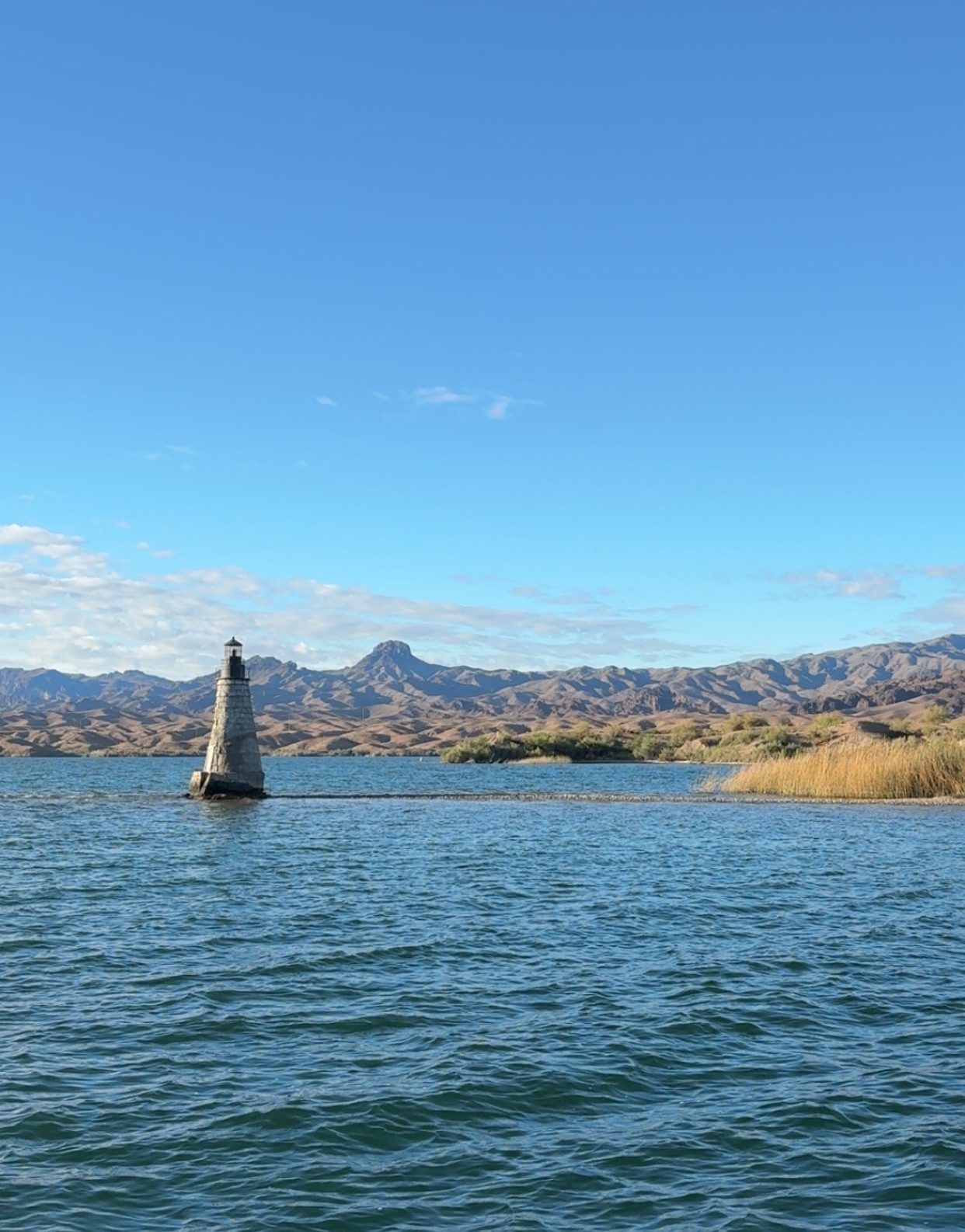
The following morning, Lyza, Tony, my father-in-law Chris, and I met Aaron at the boat launch just as the day’s first light was cresting the horizon. The deep dark blue highlighted by hues of orange set against the mountains was a sight to behold.
It was a bit chilly for Arizona, hardly 50 degrees. But the forecast called for temperatures to rise into the low 70s by late morning.
Lake Havasu is a sprawling body of water. A reservoir of the Colorado River, its19,000 acres of surface area is 35 miles long with over 400 miles of shoreline. It’s name comes from a Mojave and Havasupai word that translates to blue-green water, something that proved so be an apt description as soon as the sun came up. The turquoise was complemented by the rust colored earth of the terrain that surrounded us. In a way, it felt like we were in a lake on Mars except, you know, with oxygen.
The initial plan was to start by going after sunfish. But Aaron offered up a different idea. One of the spots closest to the launch would likely provide a solid opportunity for Tony to build some confidence. It typically held smaller striped bass that were eager to feed. So we called an audible.
I don’t want to make too many assumptions but, I am guessing Aaron had the foresight to know that the more engaged Tony was, the better this day would go for all of us. And I appreciate that thought.
Striped bass are an anadromous fish, meaning they can live in salt or fresh water. They are more closely related to sea bass than smallmouth or largemouth.
Once Aaron spotted some stripers on the fish engine, he cut the motor and we began to slowly drift. He handed us rods with dropshot rigs. The single hooks were tipped with pieces of anchovies. He instructed us to let the rig sink to the bottom, reel up the slack, and wait. If there wasn’t quick action, he suggested giving the rod a pop or two every now and again.
Lyza, Tony, and I assumed our spots on the rail in the back of the boat. Chris and Aaron took the front.
The bites came fairly quickly, but the fish weren’t sticking. Upon inspection of my technique, Aaron said that, rather than a firm hook set, I should reel down to the fish and let the natural resistance do most of the work.
Chris connected with the first fish of the day, a striped bass that was on the short side of modest. But, hey, we were on the board.
A couple minutes later, Aaron was hooked up. He immediately handed the rod to Tony who took over reeling duties. The fish eventually found its way into the boat. Tony was quite pleased. He was interested in touching the fish, but not so hot on the idea of taking a picture.
My turn came next. Heeding Aaron’s advice paid dividends on my next bite. The fish was a little nicer, but not worthy of keeping. Still, it was my first striper. I was thrilled to add another species to my angling life list.
After Chris hauled in another one, Aaron came to the back of the boat to test an additional method. He tipped a single hook with an anchovy head, casted it out, and let it naturally flutter behind the boat. The new approach quickly succeeded. Once again, Aaron relinquished control of the rod to Tony who hauled in the fish.
The action quickly dissipated after that and it was time to switch gears. We took a 20-minute ride to a cove on the California side of the lake to troll for larger stripers. As 90s country played over the speakers, Aaron ripped half a cigar out of his pack and lit it. He entertained us with stories about fishing, his days as a bouncer, and some of the rowdy party clients he’s had on the boat in previous summers.
Aaron was also great with Tony. He was patient and willing to answer his questions and have conversations with him. Our little guy warmed up to him quickly, which isn’t always the case, even with his family members.
Without the trolling motor, Aaron had to resort to keeping his main engine at a low speed. We had three lines in: two with chatter baits with paddle tail trailers and another with a paddle tail on a jighead.
“You see that? That’s what we’re looking for,” Aaron said as he gestured toward a line of suspended fish on his display.
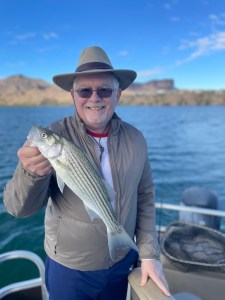
Moments later, one of the rods at the stern was pounding away. Chris grabbed it and brought the biggest fish of the day aboard. Our first keeper.
On the next pass, I got in on the action. Lyza got her chance on the next circle, and Tony got one on our last swing. Each fish found its way into the live well. We had enough keepers for dinner. That’s a win, in my book.
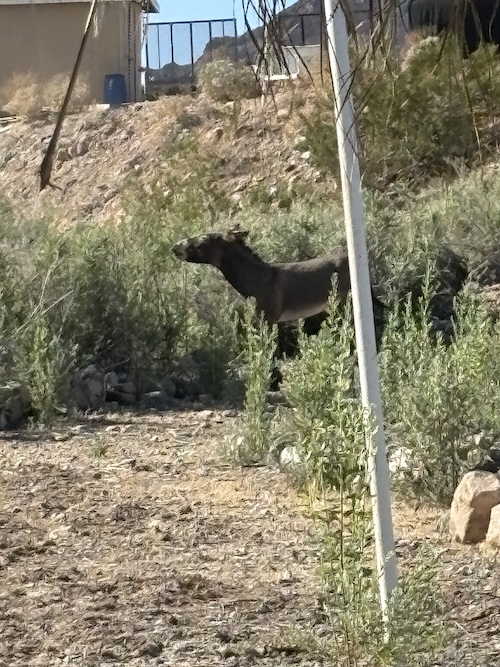
As we were making our wide passes, we were treated to the sight of some unique local wildlife: burros. These wild donkeys are descendants of the old pack animals the miners used during settlement. They roam freely about the landscape and traversed the neighborhood shoreline as though they were deer. They were in yards, on patios, in undeveloped plots munching on plants, just hee-hawing away.
Now it was finally time to chase red-ears. The plan was to sight-fish them in the shallows using dropshot rigs and worms. I eagerly awaited the chance to even see one of these fish.
We pulled up to the first spot, a rocky point across from some boat slips, where we were greeted by another feeding burro. While the shallows appeared void of fish, Aaron told us to cast in the spaces between the empty slips and slowly retrieve, bouncing bottom with the sinker as we went.
It was a fruitless endeavor.
No matter. We were off to another cove. It was intermediate voyage. That’s one of the only downfalls of fishing from a pontoon: what you gain in comfort, you lose in efficiency. It’s nearly impossible to cover water quickly.
This spot featured a steep drop-off lined with grass on the shoreline that reached up into the neighboring hill. The wind was starting to pick up, but we were protected here. The approach was the same as the prior location.
Tony took a break from fishing to feed the remaining anchovies to a pair of mallards that followed us in from the cove entrance. He was loving life and the ducks were loving him.
On the other side of the pontoon, Chris and I were starting to get bites. My heart started racing in anticipation.
“Do I need to treat these like the stripers?,” I asked Aaron.
“No. Lay the wood to these fish. We’re rippin’ lips now,” he replied.
Fine by me.
The bites kept coming. I kept setting. Still, nothing to show for it.
Aaron came to my side with his rod to show me how it’s done.
After a couple swings and misses of his own, he speculated that we might actually be dealing with bluegill.
That warranted some additional investigation. We were off to prospect some more spots. Each cove was more beautiful than the next. Unfortunately, none of them held fish.
At this point, we were roughly halfway through our full-day trip. We decided it was time to drop Lyza and Tony off at the boat launch. Chris and I would continue fishing.
We putted our way through the channel and under the London Bridge.
Now, I know what you’re thinking: isn’t the London Bridge in England? Well, yes. But get this:
In the 1960s, Robert P. McCulloch bought the original bridge from the city of London. He had it cut into pieces, had the pieces numbered and shipped to the United States. Ultimately, only the external masonry from the original bridge was used in the stateside reconstruction. The project was finished in 1971. The bridge continues to be a tourist attraction in Lake Havasu city to this day.
As we reached the end of the channel and headed back out to the big water, it became clear the wind had picked up considerably. Aaron had warned of this possibility on our call the night before.
He told me that our red-ear fishing was probably done for the day, but we could troll for striped bass to our hearts’ content.
But as we approached the dock, things got progressively worse. As I looked back over the lake, I could see white caps from waves rapidly forming and breaking.
As Aaron tied up, I realized we had no choice but to dock perpendicular to the waves. The boat began rocking violently. Lyza and Tony safely got off the boat.
He looked back at me and said, “I hate to say it, but I’m not sure we can do this. I think we might be done.”
“I agree,” I said with a chuckle.
I wasn’t happy about it, but I didn’t get the sense Aaron was either. It was still the right call.
That became increasingly clear as I held the boat for Aaron while he got his truck and trailer. At first, it took everything I had to keep the boat off the dock. Then, it took even more to keep it from drifting too far away.
Chris, understandably, wanted to get off the boat. But after briefly dealing with the intensifying rocking (and some not so subtle encouragement from me) thought better of it and took a seat.
I caught another glimpse of the lake as Aaron was trailering the boat. While I wouldn’t say the waves were Lake Michigan big, they were getting there, which is wild considering the size difference.
We were on a gorgeous lake, with a great guide. It just wasn’t in the cards for us that day. It sucks, but it happens. You don’t always get your way when you’re dealing with nature.
That night, Chris made us pan-fried striper with brown butter sauce and toasted almonds. It was delicious.
There’s a unique satisfaction that came from enjoying a fish that, just hours earlier, was swimming in the lake I could see from the dinner table.


Leave a Reply