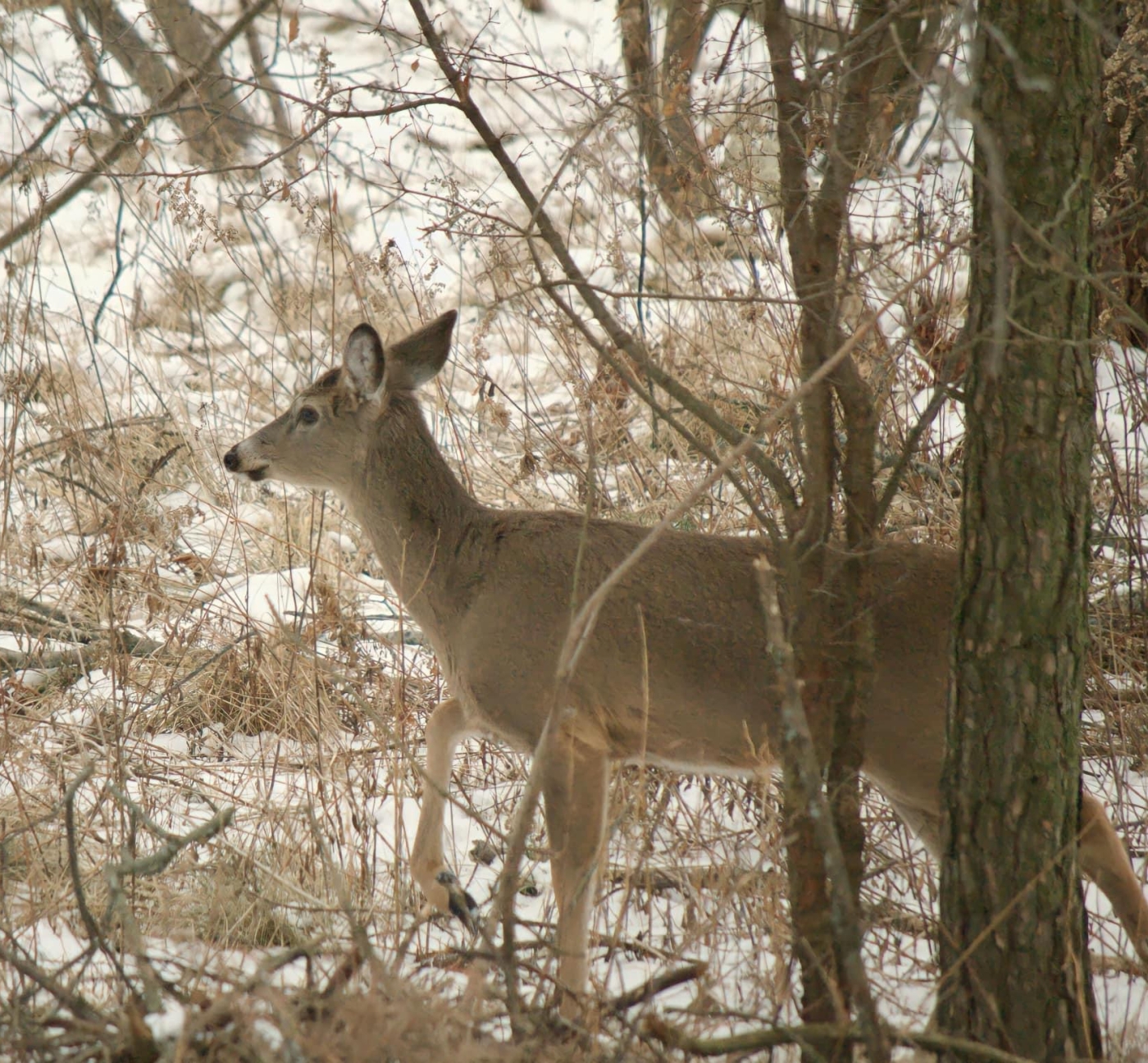
Last week, the Wisconsin Department of Natural Resources released its preliminary harvest data for the 2025 Wisconsin 9-Day Gun Deer Season.
182,084 deer were harvested during the gun season, down 0.8% from last year.
As is often the case, these numbers were met with scoffs and grumbles from some whose basic retort can be summed up as, “ain’t no deer.”
Now, to some extent, I empathize with those folks. Spending hours in a stand and not seeing deer flat-out sucks after a while. I enjoy the tranquility of nature as much as the next person but, at some point, you can sit in the woods and watch the trees grow whenever you want. The 9-day gun deer season is ultimately about harvesting deer.
This is a growing frustration with many hunters in my circle who often spend the deer season navigating a sea of trucks and blaze orange on public land or have struggled to see deer in places where they once seemed bountiful or, at the very least, common enough to provide hope of shooting opportunities. And that personal reality leads many to assert that there just aren’t as many deer as there used to be.
Last year, after a handful of conversations with those of that belief, I asked myself a simple question, “Is that true?”
Being a nerd, I was excited to get my hands on the numbers.
I myself was beginning to harbor some of those thoughts. In 2022, I saw just one deer on opening weekend after spending over 16 hours in the stand. In 2023, I shot the only deer I saw on the first day. Maybe these folks had a point.
Still, I tried to go into this research project with an open mind. There are several important things to consider.
First, and perhaps the most important, is that the gun deer season accounts for just a fraction of the deer hunting opportunities in Wisconsin. While it is the most popular season of them all, it is far from the only one. Making assumptions based on that would be risky at best. Heck, in some parts of the state, archery season runs for essentially five months. There’s a muzzleloader season, select holiday anterless-only hunts, so much more than the first two days of the 9-day gun season.
The next point of consideration was the narrative around a declining hunter population. If there are fewer people trying to shoot deer, it stands to reason that fewer deer would be shot. What did the data have to say about that?
With all of that in mind, I dove into the DNR’s numbers. Here’s what I found:
I chose to start with the DNR’s post-hunt deer population estimates. The latest numbers suggest there are roughly 1.82 million deer in our state, that’s more than two per hunting license sold. The deer out-number the hunters. That’s certainly a good thing for the orange army.
Even better, the estimated deer herd has increased by nearly 400,000 since 2007.
On top of this, the average number of deer seen per hour hunted, as reported by hunters themselves, continues to show a steady increase.
Now, I will concede (and I am nearly certain the DNR would too) that gaining a fully-accurate census of the deer herd is an impossible task. These are simply the best numbers we are able to gather and I, for one, would argue they are no less reliable than the firsthand accounts of deer sightings from those saying there aren’t as many deer to shoot as there once were. In fact, those numbers are taken into account.
Next, I went into the DNR’s harvest trend database for harvest numbers and was provided a DNR report from a reader that came via an open records request in 2022 for all of the license sale stats, with the exception of 2023 (which came from a DNR press release).
I keyed-in on two metrics: total license sales and total deer harvested, across all seasons and weapon types for the last 20 years. Using that, I put together a crude success rate that showed the number of deer harvested per license sold. I then focused on the data from 2014 onward, the timeframe since the most recent significant season structure change.
This is what that information looks like:
| Year | Deer Harvested | Licenses Sold | Ratio |
| 2014 | 305,414 | 837,780 | 0.364 |
| 2015 | 311,107 | 851,918 | 0.365 |
| 2016 | 318,506 | 827,141 | 0.385 |
| 2017 | 322,504 | 824,475 | 0.391 |
| 2018 | 336,464 | 806,442 | 0.417 |
| 2019 | 291,023 | 794,817 | 0.366 |
| 2020 | 339,901 | 823,527 | 0.412 |
| 2021 | 309,392 | 811,076 | 0.381 |
| 2022 | 340,282 | 797,856 | 0.426 |
| 2023 | 300,651 | 788,697 | 0.381 |
| 2024 | 327,950 | 790,992 | 0.415 |
I want to stress, I am not currently in possession of any single source that contains all of this information. Many of the publicly available DNR information has inconsistencies or lacks complete information. Through my research, I did the best I could to stitch together the most reliable and complete DNR sources I could (the sources linked above) to get the best data set possible.
With that said, let’s start with the harvest totals.
In 10 of 11 seasons since 2014, Wisconsin hunters have harvested over 300,000 deer. That total has been fairly steady, with the lowest total being only 6 percent below the 10-year running average and the highest total being 9 percent over that average.
License sales follow a similar trend to the harvest totals. The low point being 3 percent below the 10-year rolling average and the high point 4 percent above it.
It is worth noting, however, that license sales have surpassed 800,000 just twice since 2018, after a 16-year run of eclipsing that threshold. What’s more, preliminary data from 2024 indicates that we are potentially on-pace to continue our run of less than 800,000 annual deer hunting license sales for a third straight year.
But how successful are those hunters? That’s what matters. Harvest numbers only tell us something when given in context with the number of hunters.
The average number of deer harvested per license since 2014 is 0.376. The season with the most deer harvested per license, 2022, deviates just 0.038 points from that average. The worst season, 2014, is a mere 0.024 points from the average in that time span.
All of this is to say, when accounting for fluctuations in hunting licenses sold, Wisconsin deer hunters have essentially had the same amount of success year-over-year for the last decade.
You can sum up the last 10 years or so of Wisconsin deer hunting with these two general statements:
Wisconsin deer hunters will kill around 300,000 deer each year and somewhere around 40 percent of licenses sold will result in a successful harvest. In fact, those statements have largely held true since 2009 (but that’s a different article).
Now, if you’re one of those hunters who hasn’t been seeing deer and has made it this far through my brain dump and put up with my nerdiness, I can guess what you’re thinking: “Nathan, this is great and all but none of this makes me feel better about not seeing deer.”
Valid. This wouldn’t make me feel better either.
My point is this: there is a distinct difference between your personal experience and what is happening with the deer population in Wisconsin as a whole. Lack of deer where YOU are doesn’t necessarily constitute a decline in deer population.
If you don’t want to believe the population estimates, that’s OK. But I guess my questions to you would be this: If there aren’t as many deer, how have largely the same number of Wisconsin deer hunters been able to harvest deer at such a consistent rate for the last decade? And what explains the fact the highest success rate of the last 12 years occurring just two seasons ago?
In fact, 2022 boasted the highest annual deer harvest since the latest season structure change, a number that was reached with the second-fewest licenses sold in over 20 years.
Though, admittedly anecdotal, there are hosts of variables that could contribute to seeing fewer deer on an individual level.
For starters, it is completely possible the deer population is lower where you hunt. That’s simplest explanation, for certain. But there are other factors.
Maybe there is too much hunting pressure in your area. Maybe there isn’t enough.
Perhaps the land you hunt has changed over time and deer don’t find it as suitable as they once did.
As land that is open to legal hunting continues to dwindle, deer can increasingly be found in urban areas. After all, there is a significant difference between deer and “legally huntable deer.” Just because there aren’t deer where you are hunting doesn’t mean they don’t exist.
Are there factors that have prevented you from spending as much time in the stand as you once did?
These are just a handful of potential causes for lack of deer sightings.
Trust me, I have personally felt the frustration that comes from not seeing deer. But I’ve found little, if any data, that indicates it is related to the number of deer in Wisconsin.
 Nathan Woelfel Outdoors
A fuller picture would be developed if your data included a comparison of WHERE, in Wisconsin, deer are harvested in 2024 as compared to 2014 and then again, 2004. The movement of deer density from the north to the south over that 30 year period would answer many of the, “There ain’t no deer anymore” complaints. The old haunts where deer camps concentrated in the old cutover Northwoods are much less productive because there ARE fewer deer there today. Your data will show that change.
LikeLike
Hi Sid, thanks for reaching out.
The goal of this article is to make a simple point: It is completely possible there are less deer where you hunt. But that doesn’t necessarily mean there are less deer statewide. Both things can be true.
I didn’t include regional harvest data because I don’t feel it’s related to the point I was trying to make. In fact, I conceded, at least twice in this piece, that it wasn’t.
LikeLike
My previous comment erred in calculating the elapsed time suggested for comparing locations for harvesting. The data points should have included 1994 to cover a 30 year span.
LikeLike