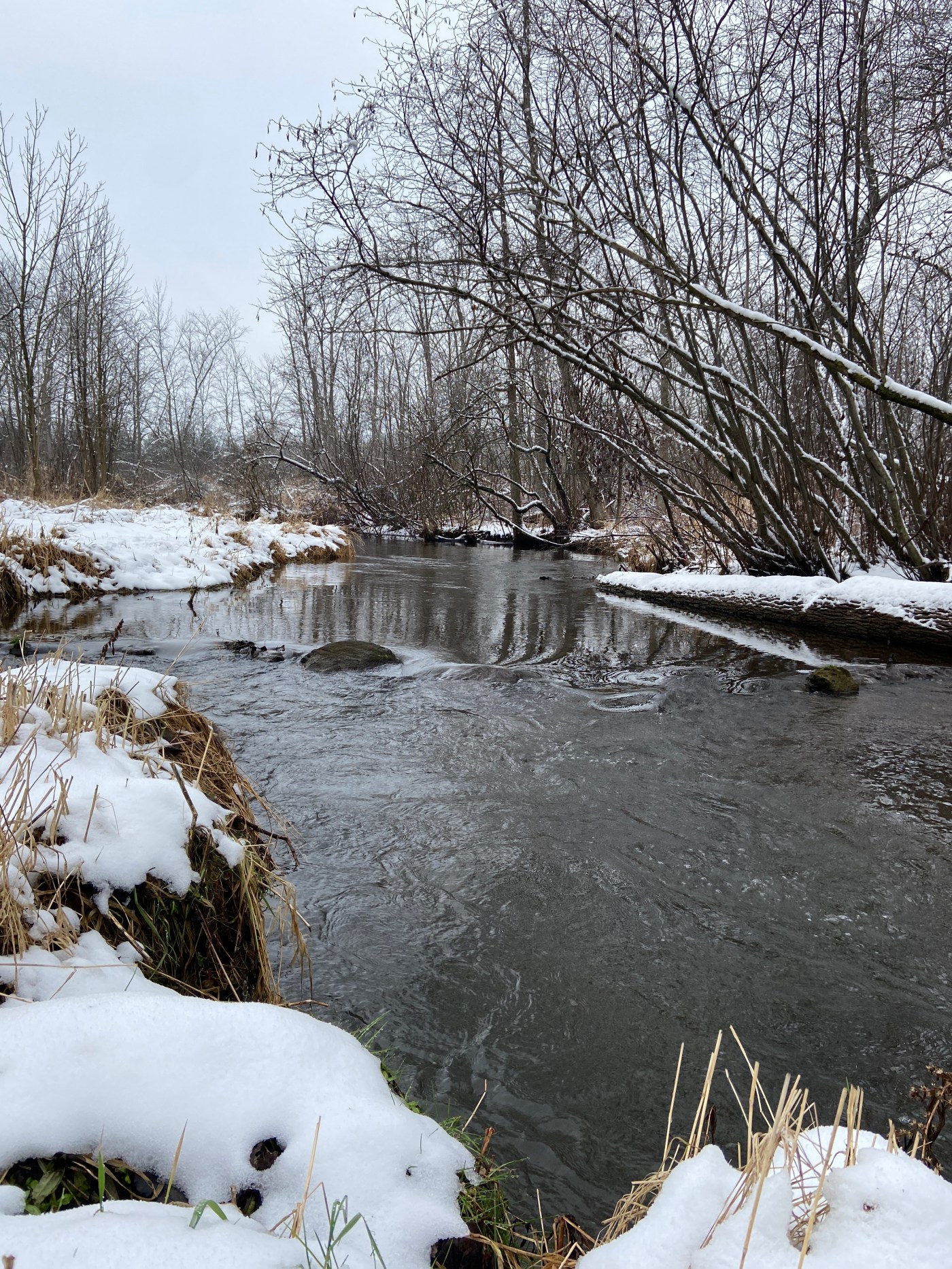
On an overcast, unseasonably mild January day, I found myself on one knee, my neoprene waders protecting my skin from the condensed pack of fading snow I was parked in.
In front of me was a small pool of the Mullet River protected by frosted cedars and plenty of downed timber. My left hand clutched the butt end of the nine-foot fly rod I had borrowed from my friend and fishing companion, Brandon. My right hand held the flies that were supposed to be attached to my tippet which now swung naked in the gentle breeze.
I was out of breath, drenched in sweat, and there was a steady stream of blood flowing out of my left thumb from an unintentionally self-inflicted wound undoubtedly caused by my haste.
There was something inside me that said I just had to get to this spot. Once I see a spot that, in my head at least, has high potential for holding fish, there’s no getting me off that trail. I’m like a bloodhound tracking a bunny. Once I’m on the scent, I am going to see it through.
Well, I did. And I payed dearly for it. I crawled on my hands and knees under downed trees, dodged thorns and did my best to navigate my fully assembled fly rod through the perils I encountered along the way, all to make it about 15 yards upriver.
While I made it to my perceived honey hole, my one-track mind prevented me from taking the proper precautions to protect my line, which was now in two pieces. This spot did me little good without a fly or two to float through it. I was frustrated.
Yet, the only thought I had in my head was,”just one little fish would make this all worth it.”
It’s amazing how quickly attitudes and perceptions can shift.
It was not all that long ago that I, a lifelong Lake Michigan fisherman accustomed to catching trout that were measured in pounds, not inches, could not understand why so many people would spend their precious time and hard-earned money chasing small, albeit beautiful fish. Part of me still doesn’t completely grasp it, though now it’s for different reasons.
You see, I am not a proper fly fisherman. I own a pair of fly rods: a discount job from a department store and another intriguing relic from early angling history that I inherited. For some reason, I have a smattering of flies I’ve managed to accrue over the years to go with these rods. Occasionally I screw around with whatever random setup I am able to assemble with these meager options, chasing smallmouth bass in the summertime when my fishing routine needs a change of pace. But that’s about the extent of my experience in this discipline.
My casting skills are questionable, even for a beginner. But they are probably more dependable than my limited ability to identify aquatic insects or my knowledge of their life cycles.
So how did I end up here, in a place I had never fished before, fly rod in-hand, huffing and puffing, perspiring, and bleeding, but still clinging to an optimistic point of view?
Actually, I arrived at this point pretty quickly. Just three weeks prior, I participated in my the inland trout fishing opener and I did so with a fly rod. It was a trip born out of necessity as much as curiosity.
It was the first weekend in January and the ice cover on area lakes and rivers was sparse, if not questionable, an issue that is rapidly becoming something of a concerning trend during winter in southeastern Wisconsin.
With ice fishing off the table, Brandon and I were assessing our open-water options via a brief text exchange on Saturday morning. He was kicking around float fishing for brown trout in the Sheboygan River, which was still wide open. Brown trout action had been hot as of late. The problem was: seemingly everyone knew that. Cars had been stacked up like a Matchbox collection in most of the best publicly accessible spots, for the better part of the last three weeks. With limited fishing time, I wasn’t sure I had the mental bandwidth or patience for dealing with the masses.
Plus, I fish the Sheboygan a lot. I was in the mood for some new water.
So I pitched the idea of fishing the Onion River for trout. It was the first day of the catch-and-release inland trout season, after all.
For some reason, I had always made a mental note of this day even though I never partook in the festivities. Perhaps it’s because of a deep-seated wonder I’ve long held about the possibilities the inland trout season holds. Maybe it’s because I’ve never fully committed to ice fishing and can’t be pulled away entirely from my heart’s desire to be a year-round open-water angler. Likely, it’s a little of both.
Regardless of my motivations, Brandon agreed to giving my option a shot. In recent years, he has become increasingly dedicated to fly fishing. He and his wife even took a trip to Canada to wrestle trout on a fly this past summer. He had a spot in mind and generously offered to outfit me with all the necessary gear.
“Are you ready for your guided fly fishing adventure?,” he asked playfully as we loaded up his fire engine red truck in my driveway.
To be honest, I didn’t have high expectations. I had never intentionally caught an inland brown trout and January didn’t exactly seem like a prime time to change that. Nonetheless, I was looking forward to trying something new and learning along the way.
On the drive to our spot, Brandon and I discussed one of the only truths I have come to learn in my minimal exposure to fly fishing, specifically when trout are the target species: the best part about fly fishing is that every detail matters. The worst part about fly fishing is that every detail matters.
Sure, you can get away with some sloppiness when trying to entice a foolish panfish or a desperate smallmouth bass that takes every opportunity to feed in a competitive environment, but trout are picky.
Tippet too short? Good luck. Fly moving at an unnatural speed? You may as well go home. And don’t even get me started on “matching the hatch.”
Add-in casting techniques and properly reading rivers, and all of these details can become overwhelming to someone trying to cut their teeth in the fly fishing game.
But, viewed more positively, this formidable plethora of minutiae can provide a thrill. It raises the stakes. To be a frequently successful fly fisherman means to be damn near perfect and I kind of like that.
After arriving at our spot, we got our gear situated. I pulled on my waders, did a final check of my fishing bag, and slid on a pair of fingerless wool gloves.
That’s when Brandon suggested that I first put on a pair of surgical gloves from the pack he had in the back of his truck. “It will keep you from getting cold because your skin won’t be wet.”
While I appreciated and agreed with his logic, I chuckled at the notion my hands would get wet today. That would mean we were handling fish, which would require catching fish.
“Oh, I plan on catching fish,” Brandon said, to my surprise. “I absolutely plan on catching fish. I’ve had days when I’ve caught more than a dozen in this stretch of the river.”
“Wait. In January?,” I pressed.
“Yeah,” he said with a laugh.
Well this certainly shifted my mindset. While I was still a bit skeptical, Brandon isn’t one for spewing out fish stories. It didn’t behoove him to embellish the truth. After all, this was my idea. I didn’t need any convincing.
We entered into the surrounding woods and made our way to the river bank. In this stretch, the Onion River was little more than a few feet wide. We were going to get up close and personal with these fish, a fact that added to the challenge as well as the intrigue.
After setting eyes on a suitable starting point, Brandon walked a few yards ahead of me. As he took the hook of his fly off the keeper, he explained that he was going to give me a crash course on the main technique we would be using today. I watched as he carefully plopped his double fly setup into the downriver side of the rock bar that was at my feet. As the flies floated, he stripped line toward his left hip to ensure his baits would move at a pace consistent with the current.
When he deemed the duration of the float satisfactory, he began the process anew. This time, I tried to pick out the flies dancing through the wonderfully clear water. As I searched for the baits, I saw a gold flash, followed by Brandon’s line going taut. On his second cast, he was hooked up. The fish exposed itself once again as it darted toward the near shoreline, then the line went limp. As quickly as it struck, the fish had escaped its predicament.
If I wasn’t excited before, I sure was now. Brandon wasn’t kidding, we were going to encounter some fish today.
At this point, I was champing at the bit, tugging at my leash. I had seen what I needed. I was ready to join the fun. I prepared my rod and line and got to work.
My primary concern was keeping my line out of the brush, something that seemed like a tall order. The river was nestled into a host of trees and bushes, we were in the middle of a woods, for God’s sake. Adding to my nervousness was the fact that the length of my leader and tippet was significantly longer than the joke of a setup I could get away with when chasing smallies. This forced longer casts than I was accustomed to and in tight quarters no less.
Miraculously, my attempts at roll casts were enough to keep me out of any clusters.
In a way, this experience brought me back to the feeling of being four years old and learning to fish. I knew what I wanted to do, I just wasn’t always capable of manifesting my vision.
Then I found myself pondering, “was that a bite?”
As we grow in our fishing experience, we all quickly learn how ridiculous that question is. But now, starting fresh, I found myself questioning nearly everything as though I was a child. It was kind of fun.
After a little while, Brandon suggested we move around and explore other spots. I’m happy he did because I found myself entering a dangerous headspace. Brandon had a couple more bites and I was clinging to this small percentage of water with the growing belief that if I just gave it enough time, I too would start getting action.
By now, I could start taking some of my casts for granted. This freed up my brain to start assessing the physical characteristics of our spots. I started asking myself, based on my knowledge of other fishing disciplines, where the fish were most likely to be and what I needed to do to provide an enticing presentation.
This proved to be a critical part of the limited success I experienced on that day. With a river this narrow and water this clear, I had to be incredibly tactical in my approach. I had to eye up spots from a distance and enter a new location with a plan already in mind. No matter how stealthy I tried to be, there were times when I would only get one shot at pool or run and I had to make it count. It felt as though I was playing chess with these fish.
As I started putting the pieces together, the bites began to stack up. Sorry, the “takes.” As Brandon astutely pointed out: it’s “bobbers” and “bites” when you’re fishing with spinning tackle. When fly fishing, it’s “floats” and “takes.” I’m still learning the jargon.
In any event, there were fish at the end of my line but I failed to keep any of them there. Still, I was having a blast.
Throughout the years I’ve learned the importance of falling in love with processes. If my satisfaction with an activity is predicated solely upon my level success, I’m not going to live a very fulfilling life. How on earth would I ever learn anything new if my happiness stemmed simply from triumphs and nothing else? You have to learn to appreciate and celebrate progress and I was making progress during this afternoon.
I try to channel my inner Ms. Frizzle by taking chances, making mistakes, and getting messy. It’s often the best way to truly learn something.
Our remaining time was dwindling when Brandon connected with another fish. This one stuck. As the swimming mass drifted into his net, I caught a glimpse of the unmistakable white halos that surrounded the fish’s array of colored spots. This was what we were here for: an inland brown trout.
The fish came as advertised, beautifully colored and small by my Lake Michigan standards, measuring about eight inches in length. The lack of stature was to be expected. This fish is a completely different strain than the one planted in the Big Pond and its growth is also stunted by the size of its environment. But, man, after a day of close calls and pouring every ounce of my fishing knowledge into our efforts, it was a welcomed sight.
I returned home that day around 2 p.m. a revitalized man. I was happy, refreshed, and ready to talk my wife’s ear off about all the fun I had and everything I’d learned. My crowning accomplishments for the day were not breaking my line off and successfully soliciting multiple strikes.
Hours later, still reflecting, I found myself occasionally recalling additional details about the outing and sharing them with my wife over dinner. She is a saint for engaging with all of my fishing talk.
That’s when my phone buzzed. It was a text from Brandon that simply read, “What do you have going on tomorrow before the Packer game?”
I knew where this was headed and it brought a smile to my face. I wanted to get Lyza’s approval before committing, but I figured now was not the time, considering we were enjoying our first sit-down dinner outside of our home in over a year.
After we returned home and with Lyza’s blessing, it was decided. Brandon and I were going to run it back in the morning. We had left too many fish on the table and it was gnawing at us. Last year, I had fly fished precisely once. Now, I was about to embark on my second trip in the span of 24 hours.
Once again, Brandon picked me up at my place and we headed to the Onion River. On the way over, he explained that we would be fishing a new stretch, one that, historically, had been even better than the waters we traversed the day before.
As soon as I set eyes on the water, I was pumped. This place just screamed trout. It looked so fishy (though, given my lack of fly fishing experience, take that opinion for what it’s worth).
I was nearly overwhelmed with the seemingly endless possibilities this spot presented. There was an abundance of juicy-looking spots and I entered the day with far more knowledge to apply than I had just a day prior.
Brandon must have shared in my excitement, it didn’t take long for us to be more than a quarter-mile apart. This happens frequently when I fish with Brandon. There are plenty of occasions when I find myself separated from the guy who drove me, for nearly an hour, with only a vague idea of where he is. I think it’s because his inner-fisherman has the same drive mine has. It’s just that, sometimes, the spirit moves him to proceed in one direction and I the other.
Bites were harder to come by on this Sunday morning, but I wasn’t discouraged. I happily wandered from spot to spot, every bend of the river revealing a scenic view even more breathtaking than the one that preceded it. I got metaphorically lost in it all. If someone had shown me the pictures I took on my phone, I’m not sure I would have believed they were taken in Wisconsin, much less in the very county I have lived in for almost my entire life.
A fresh blanket of snow, a product of the overnight hours, coated the ground and we produced the only sets of human footprints to be found anywhere along the bank, though there were plenty of new rabbit and deer tracks, accompanied by the prints of a lone coyote that had made its way through the area recently. I spent some time honing in on those tracks, making note of them whenever they reappeared, trying to imagine the landscape from the dog’s point of view.
At one point, I had strayed so far from our original location that I had to pull up the OnX app on my phone to make sure I wasn’t trespassing. (I wasn’t.)
We didn’t land any fish that day, but it was clear the roots of my newly-found addiction were taking hold. I actually found myself disappointed by the fact we encountered a cold snap during the following week because the arrival of ice likely meant the temporary end to my fly fishing adventures.
All of that brings me back to my spot on the bank of the Mullet River, crouched below the bottom limbs of the tightly-packed cedars. After about 10 days of cold, a thaw provided Brandon and I with the opportunity to bust out the fly rods once again.
We chose this spot because it was new to us and we had spent a few of the days between trips researching its potential. On paper, it seemed promising enough. It was stocked frequently and seemed accessible via satellite images. What those pictures didn’t show, however, was how different this spot was than our haunts on the Onion. The river was wider. The water was faster. The brush was thick.
We gave it the old college try, but had little to show for our efforts other than a nice little reality check.
I’m not going to sugarcoat it. We got our asses handed to us. This new portion of river chewed us up and spit us out. Looking back, I think I can count the number of quality casts and drifts I had that afternoon on one hand. But you know what? I’ll be back.
Sometimes, you don’t know how much you truly love something until you hit a rough patch. Genuine passion is proven by your dedication amid adversity, whether that be in your outdoors pursuits or life in general.
This little bump in the road has forced me to pause and reflect about how far I’ve come in such a short time. Maybe I do want to be a “proper fly fisherman,” whatever that means.
I used to feel there was a certain stench of arrogance that surrounded fly fishing. To me, it seemed being dedicated to this craft implied that you spent your free time by a fireplace, swirling a snifter of fine brandy you poured out of your crystal decanter while admiring your collection of leather-bound books. But it’s not that at all.
It’s what fishing can be in its most elevated state: scenic, serene, challenging, intimate, and thought-provoking. This isn’t an activity for the aloof, it’s one for those who thirst for knowledge and a thorough understanding of every aspect of the fish they pursue and the environments in which they live.
These experiences have reminded me of the importance of valuing progress and the growth that can come from trying new things.
It’s important to have a few things you enjoy being bad at.
I think I may have found my newest one.
 Nathan Woelfel Outdoors