Author’s Note: This is the second part of a 3-part series. If you missed Part 1, you can catch up here.
It was just after 3 p.m. on a cloudy Saturday afternoon when JT and I rolled-in to the boat launch at Baby Lake. It felt like deja vu as we once again encountered a lone vehicle without a a trailer behind it when made our way into the lot.
Given our experience back at Stony Lake earlier in the day, I had a good idea what to expect this time around. My suspicions were confirmed when an elderly gentleman emerged from the vehicle as soon as we parked.
“Hey fellas,” he said with a smile as he began a now somewhat familiar spiel about invasive species. He asked us the same questions as the volunteer at the first lake and, just as his counterpart, he was every bit as friendly.
Now, I’m a Wisconsin boy through and through. I know a thing or two about “Midwest nice.” But this trip left me convinced that there are few things that compare to “Minnesota nice.”
In any event, the volunteer gave JT’s rig the once-over and we chewed the fat about fishing and exchanged stories about our days.
As we went our separate ways, I couldn’t help but notice a brown sign a handful of yards from the dock. It read, “MUSKELLUNGE are in these waters. NO SPEARING. Minimum legal size is 54″.”
“Fifty-four inches?! Jesus. We aren’t in Kansas anymore,” I thought to myself. I’ve fished a few debatably world-class musky lakes in my day, but I’ve never personally encountered a body of water with such a formidable size limit.
Considering we were here to chase bass, the thought of apex predators the size of an average 12-year-old child cruising these waters was intimidating and a bit disheartening.
Still processing, I gestured toward the sign as JT conducted his final checks before putting the boat in the water.
“That doesn’t mean there is anything that size in here,” JT responded.
“Yeah,” I said. “But the fact they feel the need to specify that you can’t keep a 50-incher kind of hints at something, doesn’t it?”
I made my way to the dock as JT backed the boat into the water. Suddenly, a loud voice rang out. Jolting, I looked around for the source. To my knowledge, there were only three of us here. I quickly found my answer. The origin of the sound was a speaker system connected to an invasive species warning sign to my left. The recording was reminding us to thoroughly inspect our boat and trailer before and after use.
Minnesota seems particularly vigilant in the fight against invasive species. They go to great lengths to protect what they love. Between the volunteer monitors, automated recordings tripped by motion sensors, and prominent signage, I think Wisconsin could learn a thing or two.
JT slowly navigated the shallow bay near the launch as he guided his vessel toward our first spot—a rock bar sitting on the high end of a steep drop off with plenty of vegetation. Though he had never fished this lake, JT had done his homework. He studied maps and fish surveys to formulate his plan of attack. It was his belief that we should encounter more smallmouth bass than we did in the morning.
The clouds persisted with no signs of breaking. I picked up the rod with the trusty old hair jig on the end. Nearly everything about this spot seemed similar to the locations we had fished at Stony Lake—the structure, the water clarity, all of it. So, I felt it reasonable to hypothesize the bait that produced our largest fish of the morning session was my best bet on this new body of water.
We had about three hours remaining in the day and over 700 acres of water to dissect. JT’s book smarts, our combined fishing knowledge, and the electronics on the boat were all we had to make it happen.
Thankfully, the trolling motor continued to work. This meant positioning wouldn’t be an issue. At least we eliminated one variable.
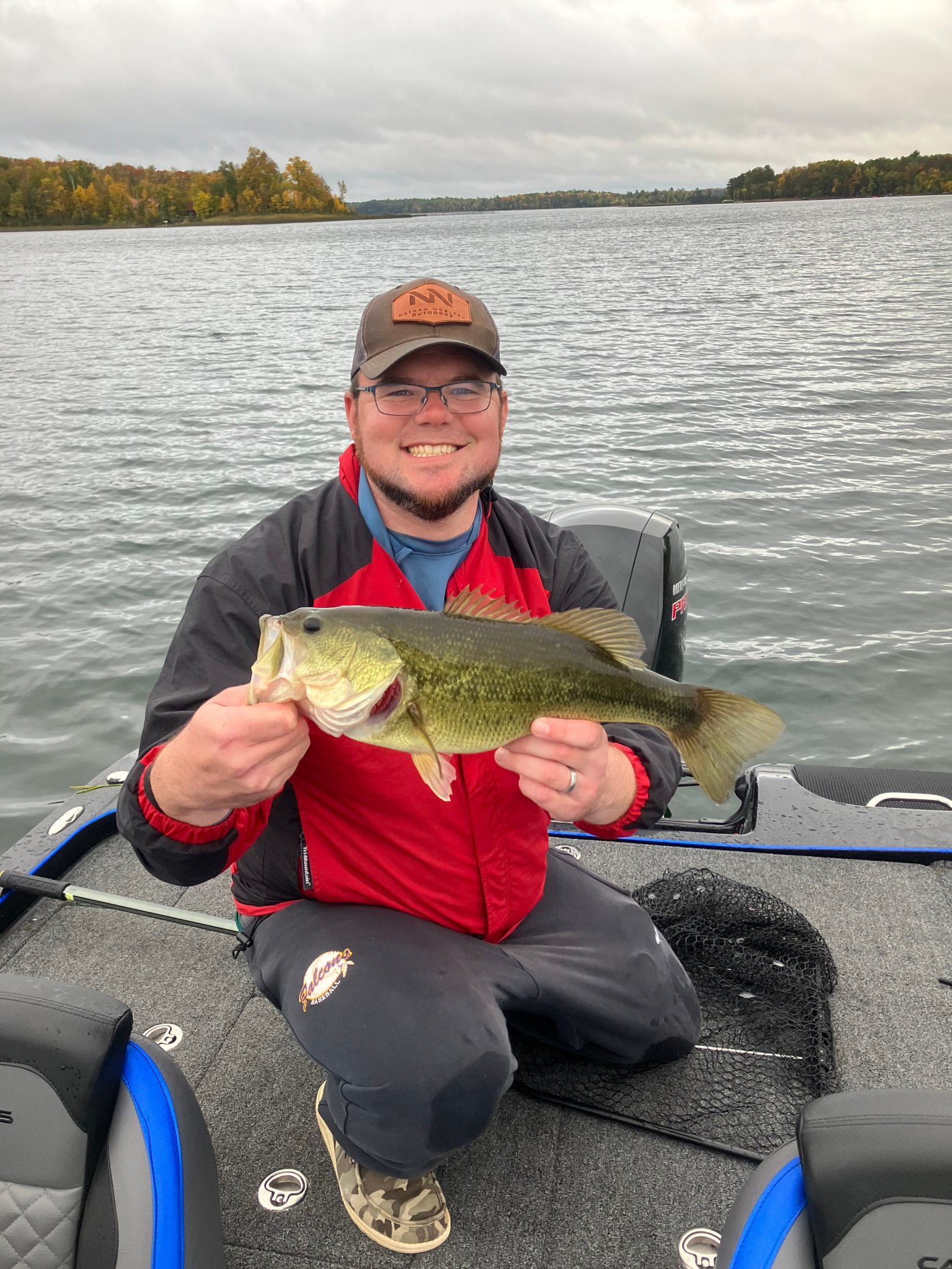
I picked up a largemouth on one of my first casts. That certainly eased the anxiety that can come with breaking down a new body of water with limited time available.
A pair of loons appeared off the bow of the boat and began diving in the water around us in search of baitfish and other aquatic delights. They didn’t seem terribly concerned with our presence and, at a couple points, were mere feet from the boat. As beautiful as that experience was, it was a little unnerving to a pair of guys who were casting baits meant to look like the forage these birds were after.
“Yeah, I don’t like this,” JT said as he put his foot to the trolling motor pedal. “We’re going to give them some space.”
He pushed the boat around the point of the rock bar and guided us toward a pencil reed patch that lined the shore. With little in the way of action, we then moved to a weedy drop-off in the middle of the lake and then on to another set of pencil reeds on the opposite shoreline.
During this time, a steady mist turned into a moderate drizzle. We zipped up our rain jackets and put our heads down, determined to find active fish.
For whatever reason, the hot baits from Stony Lake didn’t seem to be the ticket here. We began unloading the tackle box trying to find anything these fish would find enticing—top-water, swim baits, spy baits, crank baits, spinners, Alabama rigs, jerk baits, anything that would produce more frequent bites.
This can be a dangerous game, especially if you are pressed for time. It’s a constant conundrum for dedicated anglers: too little patience is foolish, but too much patience is insanity.
JT picked up a couple of fish with this shotgun approach as we cruised around the rims of bays and weed beds, but it was slow going. The rain had let up, but morale was low. We had four fish to our credit and roughly an hour of daylight left.
I plopped down in the passenger’s seat and started assessing my options. It felt like we had tried just about everything we could think of.
“We could throw a Senko,” I said half-jokingly.
Known by a few names, Senkos have long been viewed as a cheat code in the bass fishing world. The thick rubber worms can be rigged in a variety ways, opening up a host of a presentation options. The ones I use are generally four-to-six inches in length and I’ve had loads of success with them on nearly every lake or river I’ve used them on. But they are generally viewed as more of a summertime bait and the conditions we were dealing with on this day fell firmly in the scope of fall.
“I mean, you can,” JT replied in a skeptical yet encouraging manner. “I’ve got some hooks you can use.”
He dug around in one of the front compartments below the casting deck and produced a pack of hooks suitable for this situation.
With a few color options to choose from, I selected a five-inch black Senko and wacky rigged it. This weightless method puts the hook perpendicularly through the middle of the worm so it flutters on its way to the bottom.
I pitched the bait up into the reeds on the shallow side of the drop off and waited for it to slowly sink. Before I could reel-in my slack, I noticed my line beginning to swim to my right. Quickly retrieving the excess line, I gave a mighty tug.
Bingo.
As I set the hook, JT vocalized my exact thoughts. “No way!,” he shouted in disbelief as I struck pay dirt on my very first cast. I must have hit that fish square on the head.
After a nice little battle, the fish was in the net. The largemouth was pushing three pounds. This was the shot of energy we needed to get our heads right and finish the day strong.
Before JT could get the boat back into position, I pitched another cast back into the reeds. Nothing doing on the original descent. I gave the bait a gentle pull off the bottom and let it drift back down.
Bam. Hooked up again.
It felt like my bait got hit by a freight train. This fish was almost a perfect clone of the one from the previous cast. We were on to something now.
“Alright, hold on,” JT said as he reached down to pick up a Senko and hook of his own. “I’m getting in on this.”
I boated another fish before he finished re-tying, confirming JT was making the right decision.
The remainder of the night was spent hunting out spots that looked just like the spot we were in when we made our game-changing discovery.
We caught 11 fish in the final hour after having only four in the previous two.
The bite was still hot and heavy when the echos of rolling thunder became ominously more frequent. We decided to wrap up and seek cover before things got sticky. It’s a good thing we did, too. Moments after we stepped off the boat, a strike of lightning lit up the sky brighter than it had been all day. Then a downpour followed.
On the ride home, we eagerly discussed the hot dish JT’s mom had waiting for us. It was a new recipe, but we had no reason to believe it would be any less outstanding than the other meals she so graciously prepared.
It was at this point we realized neither of us had eaten anything throughout the course of our 14-hour day, sans a handful of smoked turkey sausage sticks. This hot dish was about to hastily meet its maker.
As predicted, we annihilated dinner and played a couple quick games of foosball in the basement. We called it an early night. We were spent and had nearly nine hours of driving and a Minnesota Twins game ahead of us the next day.
The following morning, we helped the neighbor get his boat out of the water. A crew was coming to remove his dock for the winter and the people who were supposed to help with the boat the previous day had bailed on him.
We made relatively quick work of the task and enjoyed a wonderful chat before we headed back to the cabin to pack up.
“Thank you for helping Bill,” JT’s dad said as soon as we came through the front door. “He is so appreciative. He will feel forever indebted to you guys.”
Honestly, it just felt good to pay it forward and help someone out of a jam. A handful of minutes for us, made a world of difference to Bill.
Before long, our trucks were loaded up and we were headed to Minneapolis. The weather held up and we were able to enjoy about half the Twins game before starting the last leg of our trip back to Sheboygan Falls.
I spent the drive reflecting on the amazing hospitality I was shown during my weekend away and shoring up my plans to ensure that I was going to return the favor.
Part 3 coming soon …
 Nathan Woelfel Outdoors