There is no shortage of anecdotal and scientific evidence that being outdoors is good for your mental health.
The ol’ “getting some fresh air” trick has done wonders for countless people, myself included.
Disconnecting from the day-to-day and experiencing the beauty of the natural world, even for a brief period has a way of re-charging our proverbial batteries and leveling us out, often bringing about feelings of peace, calm, and relaxation.
But as you spend more time alone in nature, you’ll find these experiences can offer up more complex emotions. Some that, on the surface, may not necessarily seem positive.
“If you want something you have never had, you must do something you’ve never done.”
The fact that this quote is frequently misattributed to Thomas Jefferson shouldn’t take away its sentiment. It certainly doesn’t for me.
After I came up empty in my mission to land my first inland trout on a fly rod during the early season, my friend Brandon offered me an opportunity. His family owns a cabin in Langlade County and he discovered an abundance of quality trout fishing spots during some scouting trips last year. He told me I was welcomed to join him for an adventure that would likely get me off the schneid.
It’s Episode 42 of The Nathan Woelfel Outdoors Podcast!
In this show, I discuss some things I would like all of us to think about on Earth Day and every day. We cover why I believe humans take things for granted and why our environment can’t be one of them.
Before you roll your eyes and go, “Oh great, another Earth Day think piece just like all the rest of ’em,” I hope you’ll hear me out.
Make no mistake, I am going to get up on my soap box. Today seems as good a day as any to do it. But I’m not going to take the cliche path of imploring you to plant a tree or pick up some trash. Though, those are always wonderful things to do.
In fact, even though there are loads of things we need to do to protect our planet, I’m not going to ask you to take any action at all. Not right now, anyway. My only ask of you throughout this entire would-be sermon is to stop and think. Because, unfortunately, I feel our society is in need of a mindset shift before we are capable of meaningful change.
When my wife and I bought our first home, I knew I wanted to put a bird feeder in our backyard. I greatly desired having a little slice of nature in the middle of our town.
As someone who tries to be conservation-minded, before I went to the hardware store and bought all of the necessary supplies, I stopped to ponder a question I still ask myself to this day: “Is it OK to feed wild birds?”
Spring can be one of the best seasons to catch fish.
But this time of year can also be one of the most frustrating for anglers, especially for those of us who live in places susceptible to especially volatile weather like Wisconsin.
On an overcast, unseasonably mild January day, I found myself on one knee, my neoprene waders protecting my skin from the condensed pack of fading snow I was parked in.
In front of me was a small pool of the Mullet River protected by frosted cedars and plenty of downed timber. My left hand clutched the butt end of the nine-foot fly rod I had borrowed from my friend and fishing companion, Brandon. My right hand held the flies that were supposed to be attached to my tippet which now swung naked in the gentle breeze.
I was out of breath, drenched in sweat, and there was a steady stream of blood flowing out of my left thumb from an unintentionally self-inflicted wound undoubtedly caused by my haste.
If your social media feed looks anything like mine, you’ve probably seen a post or two on your app of choice about the historic cicada hatch that is set to occur in 2024.
This once-in-a-lifetime occurrence and the fear-mongering click-generating articles that have followed provide a frustrating glimpse at how little the average member of society knows about nature and our place in it.
The gist of many of these headlines is that, for the first time in over 200 years, two different broods of cicadas will simultaneously emerge, unleashing billions of creepy crawlers across the country.
Interestingly, many of the headlines and corresponding articles use the term “invasion” to describe the natural lifecycle of insects that have lived in our midst for, arguably, most of recorded history. In fact, cicadas are native to Wisconsin. They belong here.
By definition, an “invasion” involves some level of intrusion into another’s domain. In the grand scheme of the world, humans are the ones intruding upon nature. But I digress.
So before you allow these headlines to fuel your impending sense of doom, I ask that you give me an additional minute or two of your time to calm your nerves.
While I’m not one to rant about “the media” (I used to be a full-time member of it, after all), this whole thing certainly appears to be a collective exercise in, shall we say, curated storytelling.
Because while, yes, there are two broods of cicadas hatching in the United States in 2024 and, yes, this is certainly a rare event, that’s not the whole story. You see, there’s a pesky little detail that is buried in the majority of these articles and videos with clickbaity headlines. Many of them omit it altogether.
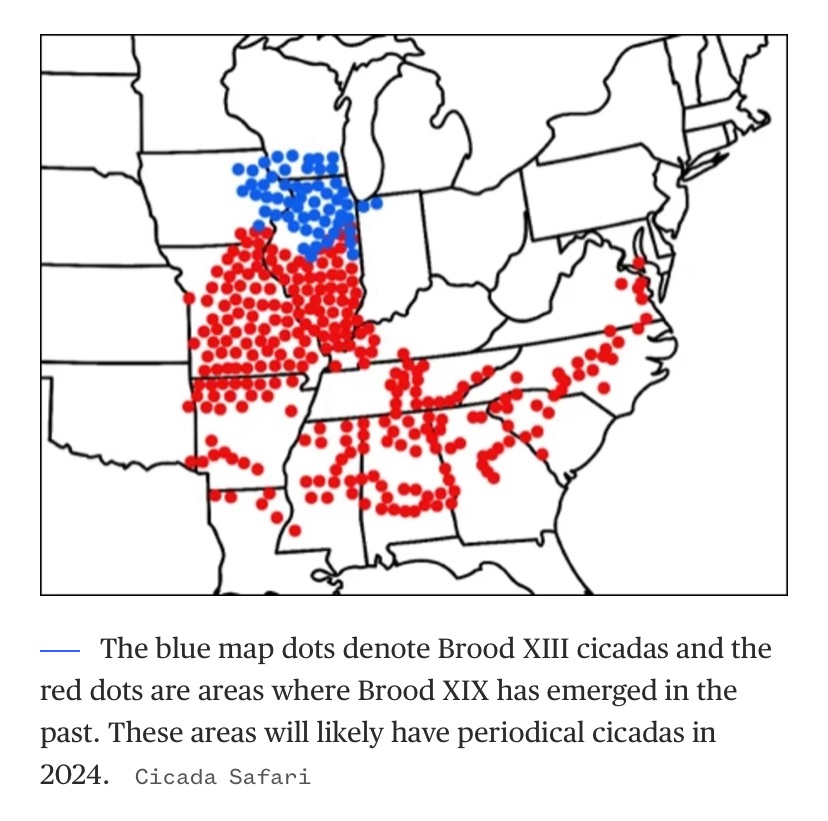
The two cicada broods in question (XIII and XIX) have different ranges. Meaning, they largely don’t live in the same places. The map below, from an NBC News article, gives a rough idea of where these particular broods are known to emerge.
See how little overlap exists?
While some scientists are excited about the potential overlap in Illinois, it’s worth noting that none of the overlap occurs here in Wisconsin.
Safe to say you don’t have to worry about seeing an apocalyptic swarm bugs in your yard this summer. In fact, it’s unlikely you’ll even notice an increased presence of cicadas at all.
In fact, few of these articles establish why this cicada hatch is even a problem to begin with. That’s largely because it isn’t one. Sure, cicadas make noise. But they are essentially harmless. We humans don’t own the world, we share it. Just because some bugs you don’t care to look at might pop up in your yard is not itself a reason to reach for the bottle of pesticide.
Whether you realize it or not, you’ve lived through plenty of cicada hatches. And considering there is no overlap of the ranges of these two broods in our state, it’s highly unlikely this one will be different than any of the others for the vast majority of Wisconsinites.
Plus, cicadas play several crucial roles as part of the larger ecosystem. They are a great food source for birds. They can improve the filtration of ground water and aerate the ground, plus they provide nutrients to the soil when they die and decompose.
Cicadas typically don’t feed on plant leaves, either. So odds are, your garden and landscaping will be just fine. Other than the bit of noise they produce for just a couple of weeks, they don’t negatively impact humans in any tangible way.
So don’t worry about the bugs. They have been living here longer than Wisconsin has been a state. There are plenty of other more worthwhile concerns in our world.
When I originally started putting together this numbers-driven yearly recap in 2020, I had two goals: the first was to show that the information and perspectives I share through my work are the product of significant personal experience.
The second was simply to let my inner nerd breathe for a little while.
This is the fourth installment of this annual series and, looking back, I am pleasantly surprised at how popular this piece tends to be. Each year, this collection of numbers is one of the 10 most-viewed pages on my site.
Thank you all for a great 2023. Let’s take a look back at the year that was:





 Nathan Woelfel Outdoors