There is no shortage of anecdotal and scientific evidence that being outdoors is good for your mental health.
The ol’ “getting some fresh air” trick has done wonders for countless people, myself included.
Disconnecting from the day-to-day and experiencing the beauty of the natural world, even for a brief period has a way of re-charging our proverbial batteries and leveling us out, often bringing about feelings of peace, calm, and relaxation.
But as you spend more time alone in nature, you’ll find these experiences can offer up more complex emotions. Some that, on the surface, may not necessarily seem positive.
A pre-dawn walk in the woods on the way to a deer stand can be a bit spooky.
Looking up into the night sky can be awe-inspiring but can also make you feel flat-out insignificant. Now that can be an empowering feeling, but it can also take some work to get there mentally.
But even the more complicated emotions can bring much-needed perspective when we adequately ponder why we feel this way.
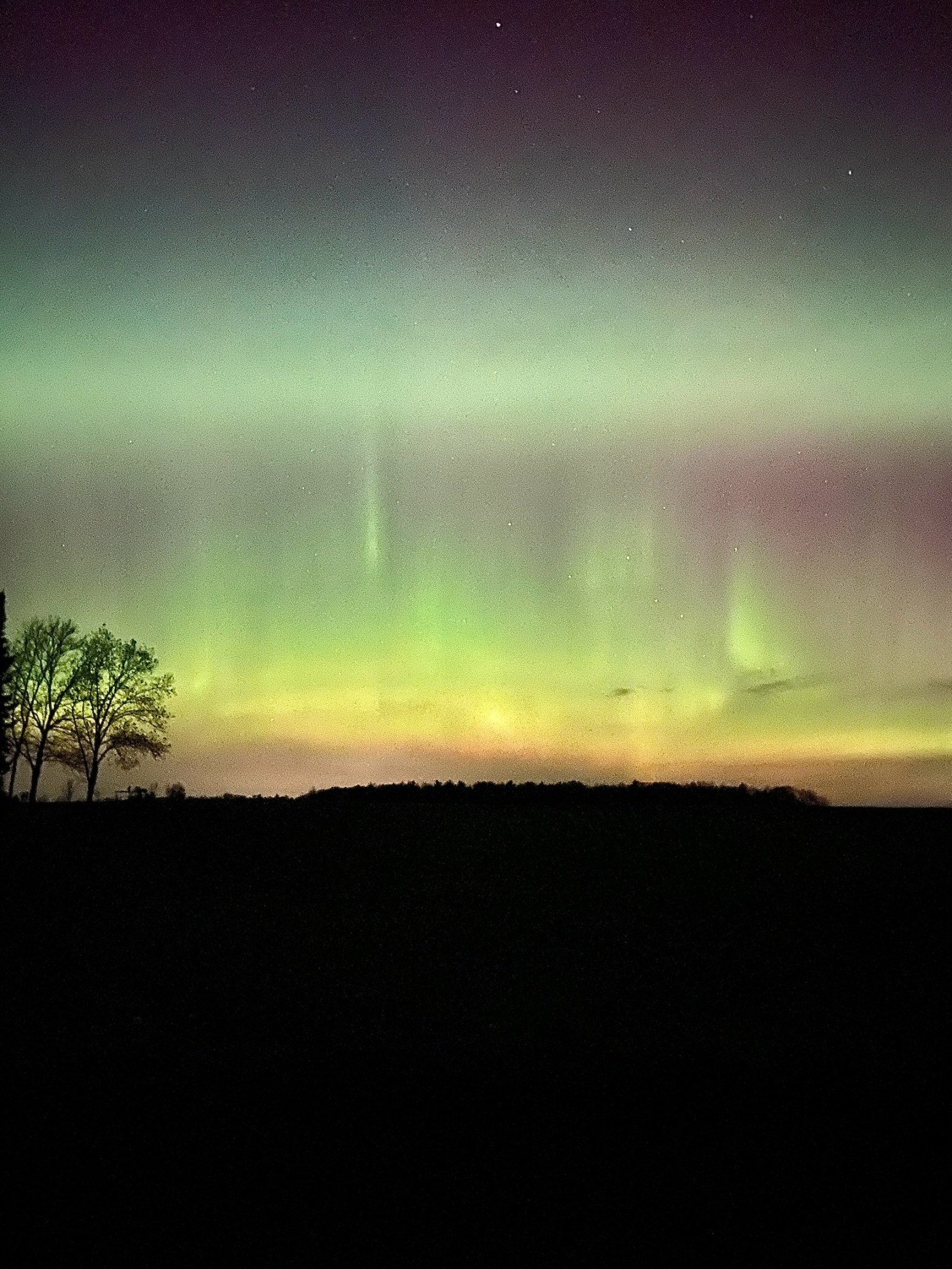
Earlier this month, as I spent the night driving around the less-populated parts of Sheboygan County in search of a proper vantage point for the most recent Northern Lights display, I started taking stock of some of the trickier feelings we sometimes experience when we are in the outdoors. I’ve thought a lot about this since then and while I don’t have as many firm answers as I’d like, I do have some theories that make a lot of sense to me.
The first thing I noticed in my pursuit of a face-to-face encounter with the Aurora was how hard it was to find anything that even remotely resembled significant darkness.
Light pollution is one of the top obstacles for viewing the Northern Lights here in Wisconsin and Sheboygan County is far from the exception. At one point, I actually pulled my truck over and brought up a light pollution app on my phone to try and find a location that would give me a fighting chance at seeing this natural wonder.
Even as I let my robot overlords guide me, I still struggled to find what I was after. Every farmhouse seemed to have at least one light near the barn that felt like it was least a billion lumens. I started to ask myself, “why are we so obsessed with lights?”
Think about it, the presence of humans does not inherently need to mean light pollution. Yes, sometimes, when it’s dark out, we need to see while we’re outside. We should absolutely be taking advantage of the technology available to us. No need to stumble around in the pitch black when there are solutions readily available. But that’s the thing: “pitch black” basically doesn’t exist anymore.
The neighborhood across the street from my house is lit so brightly by garage and house lights, even in the dead of night, that you could nearly drive down the road without headlights without having to substantially fear for your safety.
These farms, in the closest thing to the middle of nowhere that my county has, have enough juice flowing through those outdoor bulbs that you could play a football game unimpeded, despite the fact there will seldom be more than a few seconds during the overnight hours when there is another human within two miles of the place, much less a need to be outside at midnight.
Are we afraid of darkness?
Seems like it.
But why?
I’ve been chewing on that question ever since that night, roughly three weeks ago. Here’s the closest thing to an answer I can come up with: We, as humans, fear uncertainty of things we aren’t familiar with. And, increasingly, we are not familiar with darkness, nature, and each other.
Comfort ultimately comes from a willingness to first sit and deal with feelings of discomfort and collectively we are doing less of that than ever. It’s largely because we don’t have to.
Don’t like the dark? Cool, just flip on the outside lights. Leave ’em on all night and you’ll never have to confront true darkness.
Unsure about nature? That’s OK. There’s rarely, if ever, a need to be in it if you don’t want to be. Besides, there’s hardly any of it left anyway. We humans have made damn sure of that.
Don’t want to deal with people face-to-face? You don’t have to. We can do all the “connecting” we need through the wildly advanced technology nearly every person in this country has at their disposal 24 hours a day.
Now I’m not saying the modern advancements are a problem. But not acknowledging what the standard of everyday living in the 21st century has taken away from us, is. Not to mention the irony of the fact that the devices that allow us to engage with spectacles like the Northern Lights on a more frequent basis are a huge reason why we don’t look to the skies more often in the first place.
The widely available creature comforts we enjoy in this day and age are a good thing. But they put us in quite the vicious cycle.
I am a firm believer that interaction with nature and fellow people are both essential elements to human existence. But the more optional those experiences are, the harder they are to come by. All the while we become increasingly detached from things that are parts of our very DNA and, in the process, start becoming downright fearful of them. That fear leads to more avoidance and, before long, that avoidance prevents us from remember these things exist. We’ll stop thinking about the fact the Northern Lights even happen or that birds migrate and cicadas hatch. We won’t need to think about those things.
Before I become too negative, I will acknowledge I did get to view the Northern Lights and I was pleasantly surprised by how many people I encountered on my quest who were out and about, in the middle of the night, doing the same thing I was. I saw a mix of couples embracing, families with their camping chairs and popcorn, and solo onlookers all staring up in awe at the gift our galaxy was providing us.
To me, this reinforces that we truly crave these types of interactions with nature on the universe. But, ironically, in our ignorance, we are actively making these types of moments increasingly scarce.
So how do we break this cycle?
I’d say the first step is acknowledging it.
 Nathan Woelfel Outdoors
Leave a comment