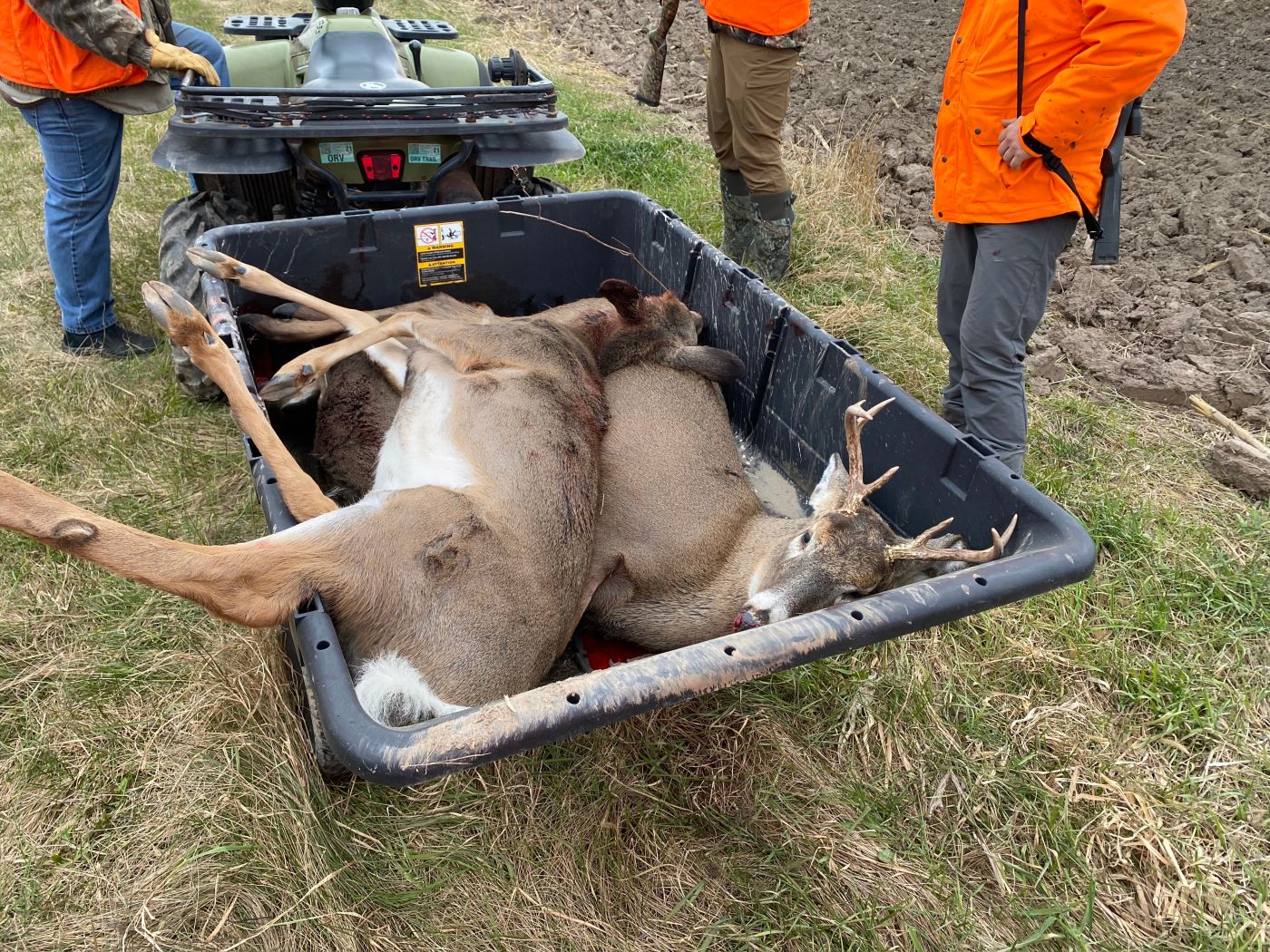
So you harvested a deer. Congratulations!
Before you dive too far into processing all of that delicious meat, it’s important that you get your deer tested for Chronic Wasting Disease, also known as CWD.
This always fatal ailment, with no known cure, has affected deer in at least 62 of Wisconsin’s 72 counties and is highly transmissible, although it hasn’t been able to infect humans yet.
Deer can spread this disease through saliva, feces, blood, or urine, among other things.
Even dead deer can spread CWD to other deer because the prions of this disease can live in soil for extended periods of time while decomposition takes place.
CWD is a serious threat to our state’s deer herd, the demise of which could send conservation into a spiral.
You see, the more impactful CWD is the fewer deer there will be. Fewer deer means fewer hunters and fewer hunters means less funds for conservation initiatives and deer hunting is one of the primary sources of revenue for such activities in Wisconsin.
If not handled correctly, CWD can severely diminish the ability of Wisconsinites to participate in an activity that is woven into the very fabric of our culture.
If that’s not enough, let’s explore some other reasons you should get your deer harvest tested for CWD.
CWD is spreading
Wisconsin’s first case of CWD was reported back in 2001. Since then, the disease has run rampant through our state’s deer herd.
How rampant?
That’s the problem. We don’t know for sure. Most deer that have CWD do not present symptoms, leaving testing as the only sure way to know if a deer is infected.
The issue is: testing rates in most counties are abysmally low most years. Last year, only 5.06 percent of all deer harvested in Wisconsin were tested.
This has left scientists, DNR officials, and hunters alike relatively in the dark regarding the true impact of this disease on one of our state’s most precious natural resources.
What we do know is that the prevalence of CWD in our deer herd is rising. In 2023, 9.2 percent of the deer sampled tested positive, more than double the positivity rate from a decade prior. That number marks a 40 percent increase in positivity rate in the last five years.
Now, under 10 percent may not seem like a scary number, especially given the relatively small sample size so far this year. But considering this disease didn’t even exist in Wisconsin two decades ago, the fact that roughly one in every 10 deer in our state is afflicted with the disease is cause for considerable concern. At the current trajectory, half of all deer in Wisconsin will have CWD in the next 25 years or so.
Southern Wisconsin is giving us a preview of what the future of our state as a whole could look like. Dane County, where CWD was first detected in Wisconsin, had a positivity rate of over 19.25 percent in 2022. Neighboring Iowa and Sauk Counties saw positivity rates of 28.2 and 26.3 percent, respectively. That’s more than one in every four deer tested.
The steady increase in positivity rates since 2001 would suggest we haven’t even put a dent in the problem. Part of that is due to a lack of data.
In order to try to get a grip on this situation, we need a more complete picture of what is going on. The only way to do that is through increased testing and that requires the cooperation of hunters like us.
Educated consumption decisions
While there are no confirmed cases of humans falling ill with CWD after consuming a deer that tested positive for the disease, the Wisconsin Department of Health Services, World Health Organization, and Centers for Disease Control all advise against eating CWD-positive deer.
It is important to know what you’re dealing with so you can make your own educated decisions before you sit down at the dinner table.
Testing is free and easy
You can drop off a sample for testing at one of the DNR’s numerous sites throughout the state. All of the self-service locations are open 24 hours a day.
All you need to do is submit your deer head, with at least five inches of neck attached, at one of the sites and fill out a short piece of paperwork. This process won’t cost you anything other than a few minutes of your time.
You can find more information on this process here.
You have options
Want to keep your deer head for a mount, no problem. Your deer can still be tested for CWD.
The DNR also provides instructions for this process at the link above.
If you are so inclined, you can even extract the lymph nodes yourself and submit those for testing. Just follow these steps.
Learn more
To hear more about the state of CWD in Wisconsin, check out Episode 24 of The Nathan Woelfel Outdoors Podcast with special guest Patrick Durkin. You can listen with the player below or wherever you get your podcasts.
 Nathan Woelfel Outdoors
I agree that the risk of a CWD jump from deer to humans (like Mad Cow disease, another prion disease, jumped from beef cows to humans in UK did) is a concern that ought to warrant having harvested deer tested for CWD before consumption. DNR policies applied in real world circumstances however, make doing so pointless for most Public Land only hunters who are concerned. Traditionally, most commercial deer processors mixed meat from different hunters’ deer when producing mixes of pork/beef with venison for hamburger and/or making sausage products because it was not cost efficient to separately fully process meat from individual deer into such finished products. Hunters received back finished products in weights approximated from the weight of the field-dressed deer brought to the processor. Pre-CWD, many commercial processors would, upon request, butcher a hunter’s deer and even make pork/beef-venison mixed hamburger from some it of its meat, separately from others’ deer, before returning only that meat to the same hunter if he or she did not order any sausage products. 20 years down the road, for reasons not completely clear to me but which I suspect are related to increased labor costs and perhaps stricter meat processing regulations, an internet search today will yield very few remaining wild game processors anywhere in the State that will accept whole deer carcasses for any form of butchering/futher processing and pledge to return only meat to an individual hunter that came only from his or her carcass. Meanwhile, DNR rules forbid leaving any part of a harvested deer other than entrails from field-dressing “in the field’ on public land but prohibit the transportation of any part of the remainder of the carcass, other than deboned meat and quarters, more than one county over from any county designated by DNR as a CWD zone unless transported to a licensed commercial processor. While the DNR provides a fairly well distributed supply of dumpsters sprinkled around the state designated for disposal of the unused portions of deer carcasses, together with sites where heads can be submitted for CWD testing, the existing regulatory situation in the context of scarcity of commercial processors willing to accept whole deer carcasses for individual processing forces Public Land hunters who harvest a a deer in a CWD zone (which cover most of the bottom 2/3 of the State, i.e., where the majority of the deer herd lives), and who strive to follow all regulations, to either only hunt in a non CWD zone or: 1) Quarter or debone all meat themselves in the field( a process that is difficult even if one packs in the extra 5 pounds or so of relatively bulky portable cacass hoist gear and happens to shoot the deer in an area where appropriately sized and limbed trees are readily available) 2) Carry all deboned meat and quarters, including the spine and head still attached to one of no more than 5 total pieces (not counting hide and legs), out of the field home; 3) Drive to a DNR site, separate the head from the spine, drop the spine and all other parts besides deboned meat and quarters into a designated dumpster, and fill out the necessary online or paper form and drop the head into a different dumpster for CWD testing; 4) Store the usable meat at home until CWD test result is received; 5) Self-perform any further meat processing at home, e.g. grinding and mixing for hamburger and any sausage making. I have been hunting public land for 30+ years. This is a daunting, inefficient, and expensive proposition for the vast majority of public land hunters, particularly new hunters who have not been raised in a farm setting where self-deer processing traditions and knowledge are strongest. Judging from the comments I hear from most other public land deer hunters I have talked to about this issue, the typical attitude is either that the CWD threat must be some kind of a hoax or that, since the DNR makes rules which are so hard to follow, its OK to just give up trying to follow them. The simplest and most equitable solution would be to require all deer shot to be CWD tested, and for all commercial meat processors who process venison, to accept whole carcasses, wait for negative CWD results before processing, and safely dispose of all carcasses testing positive. No doubt, the commercial processing industry would have to incur substantial freezer storage space, energy, and labor costs in order to remain in the venison processing business. I would be in favor of the State subsidizing some of those costs at taxpayer expense. The State gives billion dollar sports franchises hundreds of millions for stadiums and should be willing and able to set aside some funds for conserving deer hunting for the average Joe and Jane Citizen. Some of the increased cost could be passed on to hunters through increased license fees and processing fees, who I think would be willing to accept it.
Currently,DNR proponents of CWD testing in Wisconsin are whistling past the graveyard. I just read something that claimed that only just over 5% of deer harvested around the State are voluntarily submitted by hunters for CWD testing.
I would also like to hear what, if any, research the DNR is conducting/sponsoring into methods of defeating the actual prion mechanism of disease. All I have heard for the last 20 years from DNR is that “we need more data about the spread of CWD among the herd.” Data about static prevalence in given locations, together with the obvious dynamic spread and increase in positivity of the small sample sizes actually being tested strikes me as not reasonably calculated, by itself, to lead to a means of stopping the disease from infecting and killing deer.
LikeLike