
If your social media feed looks anything like mine, you’ve probably seen a post or two on your app of choice about the historic cicada hatch that is set to occur in 2024.
This once-in-a-lifetime occurrence and the fear-mongering click-generating articles that have followed provide a frustrating glimpse at how little the average member of society knows about nature and our place in it.
The gist of many of these headlines is that, for the first time in over 200 years, two different broods of cicadas will simultaneously emerge, unleashing billions of creepy crawlers across the country.
Interestingly, many of the headlines and corresponding articles use the term “invasion” to describe the natural lifecycle of insects that have lived in our midst for, arguably, most of recorded history. In fact, cicadas are native to Wisconsin. They belong here.
By definition, an “invasion” involves some level of intrusion into another’s domain. In the grand scheme of the world, humans are the ones intruding upon nature. But I digress.
So before you allow these headlines to fuel your impending sense of doom, I ask that you give me an additional minute or two of your time to calm your nerves.
While I’m not one to rant about “the media” (I used to be a full-time member of it, after all), this whole thing certainly appears to be a collective exercise in, shall we say, curated storytelling.
Because while, yes, there are two broods of cicadas hatching in the United States in 2024 and, yes, this is certainly a rare event, that’s not the whole story. You see, there’s a pesky little detail that is buried in the majority of these articles and videos with clickbaity headlines. Many of them omit it altogether.
The two cicada broods in question (XIII and XIX) have different ranges. Meaning, they largely don’t live in the same places. The map below, from an NBC News article, gives a rough idea of where these particular broods are known to emerge.
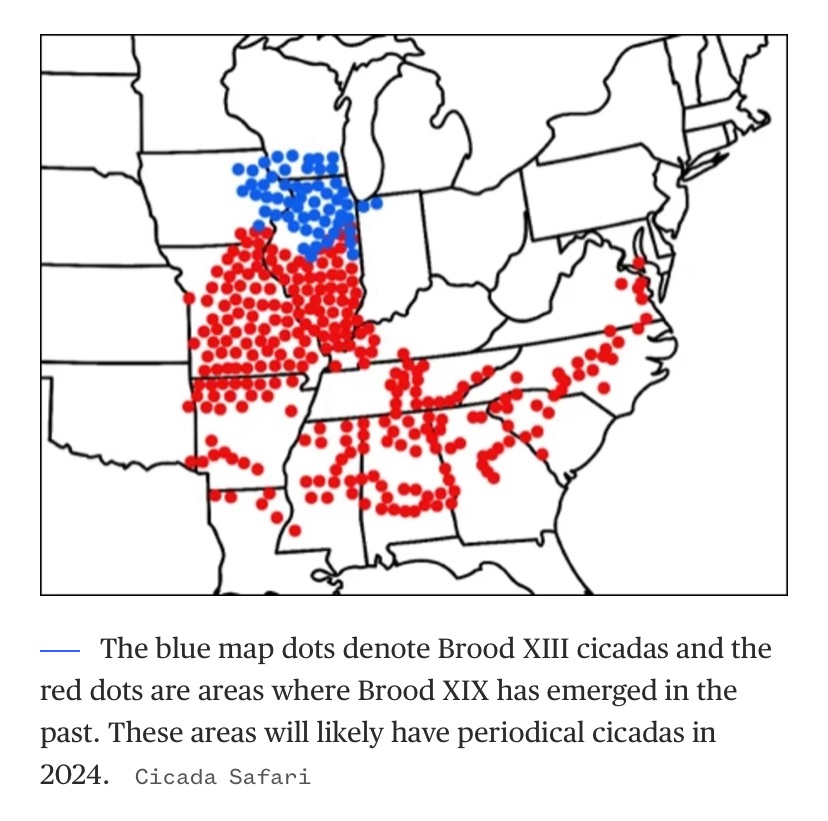
See how little overlap exists?
While some scientists are excited about the potential overlap in Illinois, it’s worth noting that none of the overlap occurs here in Wisconsin.
Safe to say you don’t have to worry about seeing an apocalyptic swarm bugs in your yard this summer. In fact, it’s unlikely you’ll even notice an increased presence of cicadas at all.
In fact, few of these articles establish why this cicada hatch is even a problem to begin with. That’s largely because it isn’t one. Sure, cicadas make noise. But they are essentially harmless. We humans don’t own the world, we share it. Just because some bugs you don’t care to look at might pop up in your yard is not itself a reason to reach for the bottle of pesticide.
Whether you realize it or not, you’ve lived through plenty of cicada hatches. And considering there is no overlap of the ranges of these two broods in our state, it’s highly unlikely this one will be different than any of the others for the vast majority of Wisconsinites.
Plus, cicadas play several crucial roles as part of the larger ecosystem. They are a great food source for birds. They can improve the filtration of ground water and aerate the ground, plus they provide nutrients to the soil when they die and decompose.
Cicadas typically don’t feed on plant leaves, either. So odds are, your garden and landscaping will be just fine. Other than the bit of noise they produce for just a couple of weeks, they don’t negatively impact humans in any tangible way.
So don’t worry about the bugs. They have been living here longer than Wisconsin has been a state. There are plenty of other more worthwhile concerns in our world.
 Nathan Woelfel Outdoors